A man stands with his back to us on a rocky summit, gazing over a surging sea of fog towards distant peaks. What is he thinking? We cannot see his face; we can only look with him. The painting is the defining image of Romanticism, a symbol of the individual's solitude and awe before nature and the unknown.
Key facts
- Artist
- Caspar David Friedrich1774–1840 · German
- Date
- c. 1818
- Period
- Romanticism1790–1850
- Medium
- Oil on canvas
- Dimensions
- 94.8 × 74.8 cm
- Location
- Hamburger Kunsthalle Hamburg, Germany
Actual size
Compared with an adult 170 cm tall
Palette
#2D261B#9A9BA4#B3B1B7#CFCBCC#7C7E81Background
Friedrich lived in Dresden and often sketched in the nearby Elbe Sandstone Mountains, now known as Saxon Switzerland. The scene is not a single place but an ideal landscape assembled from peaks and rocks in several of his sketches.
The man wears a dark green coat, an “Old German” style of dress that carried patriotic meaning after the Napoleonic Wars. Some scholars suggest the painting may commemorate an officer who died in the Wars of Liberation.
The painting's early history is obscure; it resurfaced in the early twentieth century and was bought by the Hamburger Kunsthalle in 1970. It has since become the emblem of German Romanticism and of the Romantic movement as a whole.
Technique & composition
stands at the exact centre, shown as a , a figure seen from behind. It is Friedrich's signature device: we cannot see his expression, so we step into his place and share his gaze.
The composition is broadly symmetrical: the dark and figure form a stable triangle in front, while the fog and mountains fade layer by layer behind, creating infinite depth. His head sits exactly where the slopes on either side converge, drawing the eye to him.
The fog is painted in soft greys, whites and pale violets, rolling like ocean waves. With fine brushwork and cool colour, Friedrich creates an atmosphere at once serene and awe-inspiring.
Details
Symbolism
The sublime
The eighteenth-century thinkers Burke and Kant described the : the mix of fear and awe we feel before vast, dangerous or unfathomable nature. The wanderer on the brink of the cliff above the fog embodies this feeling.
The journey of life
The wanderer holds , as if he has climbed a long way to reach the summit. The fog hides the way ahead, a symbol of the unknown future; many read the painting as a meditation on life, death and eternity.
God in nature
Friedrich was a devout Lutheran who believed God revealed himself in nature. “The painter should paint not only what he sees before him, but also what he sees within him,” he said. The fog and peaks are thus not merely scenery but an image of the spirit and of faith.
Stories
- Did you know?
The flat-topped mountain on the right is generally identified as the Zirkelstein in Saxon Switzerland; the conical peak on the left may be the Rosenberg in Bohemia.
- Did you know?
It is one of the most common paintings on book covers, especially philosophy; editions of Nietzsche, Schopenhauer and countless books on Romanticism use it.
- Did you know?
Friedrich was almost forgotten after his death until a major exhibition in Berlin in 1906 brought him back to attention.
Legacy
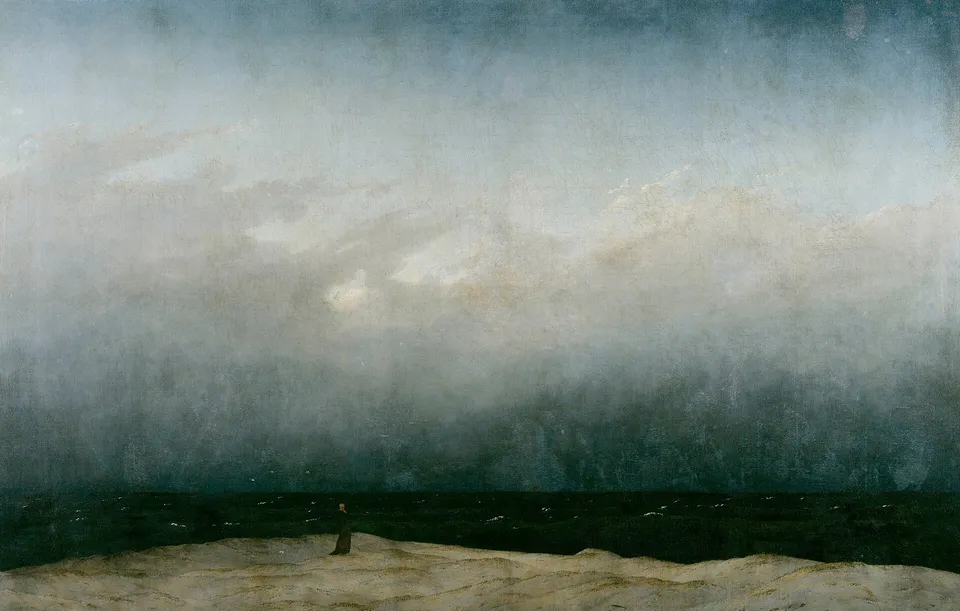
Wanderer above the Sea of Fog has become shorthand for Romanticism, symbolising individualism, reverence for nature and longing for the infinite. It has influenced landscape painting, film composition and photography, and the image of a lone figure on a height, back to the camera, is endlessly imitated.
Critics have also seen the twentieth-century Abstract Expressionist Mark Rothko as continuing Friedrich's quest for the sublime and the infinite.