At night on the outskirts of Madrid, a French firing squad takes aim at unarmed civilians. A man in a white shirt flings up his arms in the face of death. Goya's indictment of wartime atrocity has been called the first truly modern painting of war.
Key facts
- Artist
- Francisco Goya1746–1828 · Spanish
- Date
- 1814
- Period
- Romanticism1790–1850
- Medium
- Oil on canvas
- Dimensions
- 268 × 347 cm
- Location
- Museo del Prado Madrid, Spain
Actual size
Compared with an adult 170 cm tall
Palette
#1D1812#322A1E#4F3F2C#6E5941#977A56Background
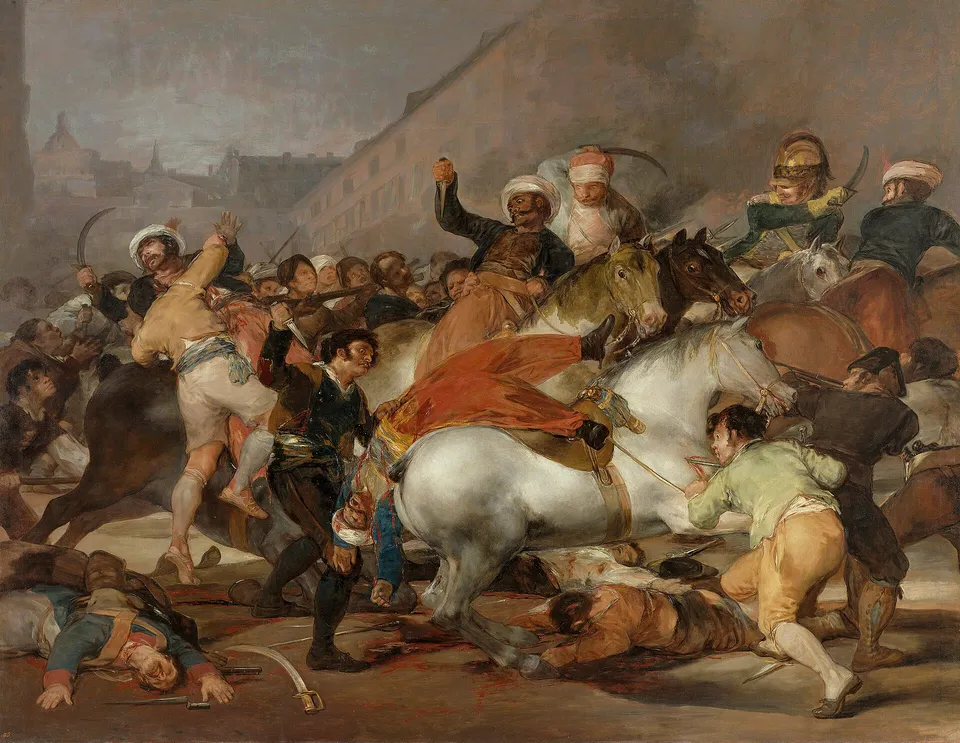
In 1808 Napoleon occupied Spain and installed his brother Joseph as king. On 2 May the people of Madrid rose against the French; in the early hours of the next day, French troops carried out mass executions of insurgents and innocent civilians on the Príncipe Pío hill and elsewhere outside the city.
In 1814, after the French were driven out, Goya asked the provisional government for support to “perpetuate by means of the brush the most notable and heroic actions of our glorious insurrection against the tyrant of Europe”. He painted a pair: The Second of May 1808, showing the uprising, and this picture of the executions the following day.
The painting was not grandly displayed; the restored King Ferdinand VII showed little enthusiasm for it. It spent years in storage at the Prado and was only fully appreciated in the late nineteenth century.
Technique & composition
The only light comes from on the ground. It floods and the other victims, while the firing squad is left in shadow. Light divides victims from executioners.
stands with its back to us in a rigid line; not a single face is visible, and the rifles form one cold straight line. They seem less like men than a killing machine.
Goya's brushwork is rough and rapid; and pools of blood in the foreground are painted in bold, unpolished strokes. This directness defies the idealised beauty of Neoclassicism.
Details
Symbolism
A modern martyr
The man in white spreads his arms like Christ on the cross; look closely and there is a mark like a stigma on his right palm. Goya made a nameless civilian into a martyr, condemning violence against the innocent.
War without heroes
Traditional battle paintings glorified generals and victory; Goya turned to the terror of ordinary people: some , some pray, some collapse. There is no glory here, only death.
The silent church
In the background, the dark town and stand coldly, unresponsive to the slaughter, perhaps suggesting the powerlessness of religion in the face of war.
Stories
- Did you know?
Around the same time Goya made more than eighty etchings, The Disasters of War, recording atrocities even more bluntly; they were not published in his lifetime.
- Did you know?
During the Spanish Civil War the Prado evacuated the painting with other treasures; the truck carrying it had an accident on the way, and traces of the damage are still visible.
- Did you know?
It is sometimes said that Goya witnessed the aftermath of the executions himself, but there is no firm evidence.
Legacy
The Third of May 1808 inaugurated the tradition of depicting war from the victims' point of view. Manet's Execution of Emperor Maximilian and Picasso's Guernica and Massacre in Korea directly inherit its composition and spirit.
It also shaped photojournalism and anti-war art; the civilian with raised hands before the guns became a heartbreaking recurring image in the war photography of the twentieth century.