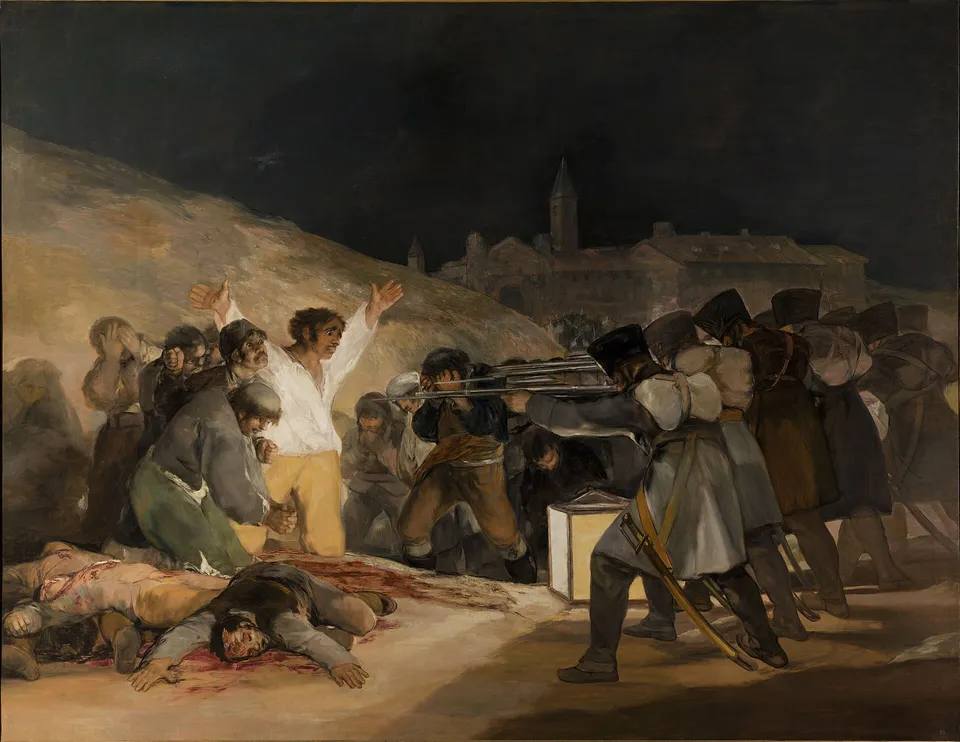
In a Madrid street, civilians armed with knives hurl themselves at the Egyptian Mamluk cavalry of the French army, dragging riders from their saddles and stabbing their horses; the whole picture is a confused, hand-to-hand struggle. Goya painted the day of the uprising as a pair with The Third of May 1808, which shows the executions that followed, recording the Spanish people's desperate revolt against Napoleon.
Key facts
- Artist
- Francisco Goya1746–1828 · Spanish
- Date
- 1814
- Period
- Romanticism1790–1850
- Medium
- Oil on canvas
- Dimensions
- 268.5 × 347.5 cm
- Location
- Museo del Prado Madrid, Spain
Actual size
Compared with an adult 170 cm tall
Palette
#77614B#63472E#907E69#482F19#271507Background
In 1808 Napoleon sent troops into Spain on the pretext of marching on Portugal, and lured the Spanish royal family to France. On 2 May, hearing that the last members of the royal family were about to be taken away, the people of Madrid rose up around the Puerta del Sol, attacking the French with knives and makeshift weapons.
The French commander Joachim Murat sent in troops including the Mamluks of the Imperial Guard. These elite horsemen from Egypt reminded the people of Madrid of the centuries of Moorish rule, and their presence fuelled the fury.
After the French were driven out in 1814, Goya wrote to the provisional government asking to “perpetuate with the brush the most notable and heroic actions of our glorious insurrection against the tyrant of Europe”. He then painted this picture and The Third of May 1808.
Technique & composition
There is no central figure and no hero. Men, horses and blades are tangled together in a churning horizontal whirl: , , — fighting everywhere. Goya captured the violence and chaos of the mêlée itself.
The brushwork is rapid and rough; many passages are just a few strokes of colour. are veiled in dust, making the struggle in front stand out, while red cloth and blood flash harshly against the grey-brown tones.
Details
Symbolism
A people's uprising
The insurgents are not soldiers but with nothing but knives and rage. Goya celebrates not generals but the courage of ordinary people pitting their bodies against a powerful army.
No victors
There is no clear winner: include civilians and soldiers alike. Unlike the glory of traditional battle painting, Goya shows killing equally brutal on both sides, anticipating his later indictment of violence in The Disasters of War.
Stories
- Did you know?
In 1937, during the Spanish Civil War, the Prado evacuated its treasures to Valencia; the lorry carrying this painting had an accident on the way and the left side was badly torn. For the bicentenary of the uprising in 2008 the museum completed a restoration and re-exhibited the pair.
- Did you know?
and cross at the top of the picture; the two foreign uniforms reflect the multinational make-up of the French army.
Legacy
It is quoted less often than The Third of May 1808, but its replacement of order with chaos and heroes with civilians equally transformed history painting. Hung side by side in the Prado, the two are key symbols of Spain's national memory.