A tiny monk stands alone on a dune before a black sea and a misty sky that fills three-quarters of the canvas. There is no ship, no tree, nothing to hold on to. Friedrich stripped landscape almost to emptiness; the picture astonished its first viewers and is counted among the most radical landscapes in Western art.
Key facts
- Artist
- Caspar David Friedrich1774–1840 · German
- Date
- 1808–1810
- Period
- Romanticism1790–1850
- Medium
- Oil on canvas
- Dimensions
- 110 × 171.5 cm
- Location
- Alte Nationalgalerie Berlin, Germany
Actual size
Compared with an adult 170 cm tall
Palette
#A7AFAB#BCC2BD#65736C#869593#0A1B0EBackground
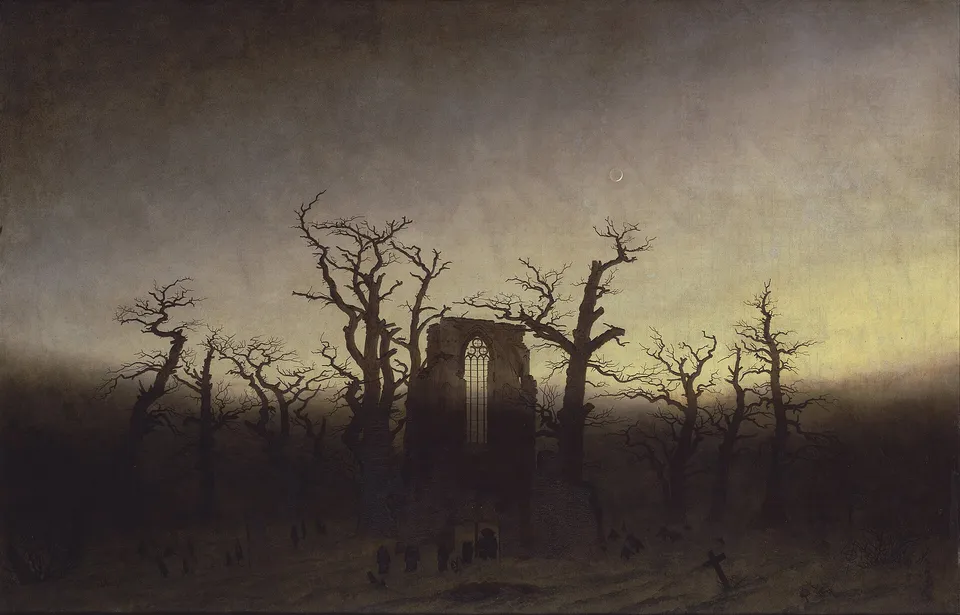
Friedrich painted it between 1808 and 1810, drawing on the Baltic coast near the island of Rügen. In 1810 he showed it at the Berlin Academy exhibition side by side with The Abbey in the Oakwood, and the two became a pair.
After seeing the exhibition, the fifteen-year-old Crown Prince of Prussia persuaded his father, King Frederick William III, to buy both paintings. The purchase made Friedrich famous, and that same year he was elected a member of the Berlin Academy.
Infrared examination has shown that Friedrich originally painted several sailing ships on the sea, then painted them all out, making the scene even emptier and lonelier.
Technique & composition
The picture is built from three horizontal bands: at the bottom, a narrow strip of almost black , and above. Traditional landscapes used trees, buildings or figures to lead the eye into depth; here there are no such framing devices, and the viewer is thrust straight before boundless space.
The sky grades from dark grey near the horizon to blue at the top, crossed by . Friedrich built up the mist with many thin layers of paint; only a few flicker above the sea, emphasising the vastness.
Details
Symbolism
The individual before infinity
is so small he is almost lost, a symbol of human smallness before the universe and God. This is the Romantic : the mixture of dread and fascination we feel before the infinite.
Faith and doubt
Facing the dark sea, the monk may be contemplating death and eternity. Some scholars see him as Friedrich himself; the picture offers no answer, only silence.
Stories
- Did you know?
The writer Heinrich von Kleist wrote in his review that looking at the picture was “as if one's eyelids had been cut away” — one could not close one's eyes against its emptiness.
- Did you know?
Between 2013 and 2016 it was restored together with The Abbey in the Oakwood; removing yellowed varnish revealed the subtle blue-grey gradations of the sky again.
Legacy
By replacing narrative with vast, nearly monochrome space, The Monk by the Sea is seen as a distant ancestor of twentieth-century abstraction; Mark Rothko's colour-field paintings are often compared with it.