On a winter evening, a procession of monks carries a coffin through the ruins of a Gothic abbey, surrounded by dead oaks and leaning crosses. In this dark, mysterious painting Friedrich meditates on death, faith and hope.
Key facts
- Artist
- Caspar David Friedrich1774–1840 · German
- Date
- 1809–10
- Period
- Romanticism1790–1850
- Medium
- Oil on canvas
- Dimensions
- 110.4 × 171 cm
- Location
- Alte Nationalgalerie Berlin, Germany
Actual size
Compared with an adult 170 cm tall
Palette
#271F1F#8A7D6D#B2A484#665C51#4C4137Background
The ruin is based on Eldena Abbey near Friedrich's home town of Greifswald. The medieval monastery was destroyed in the Thirty Years' War, and Friedrich sketched it many times as a young man.
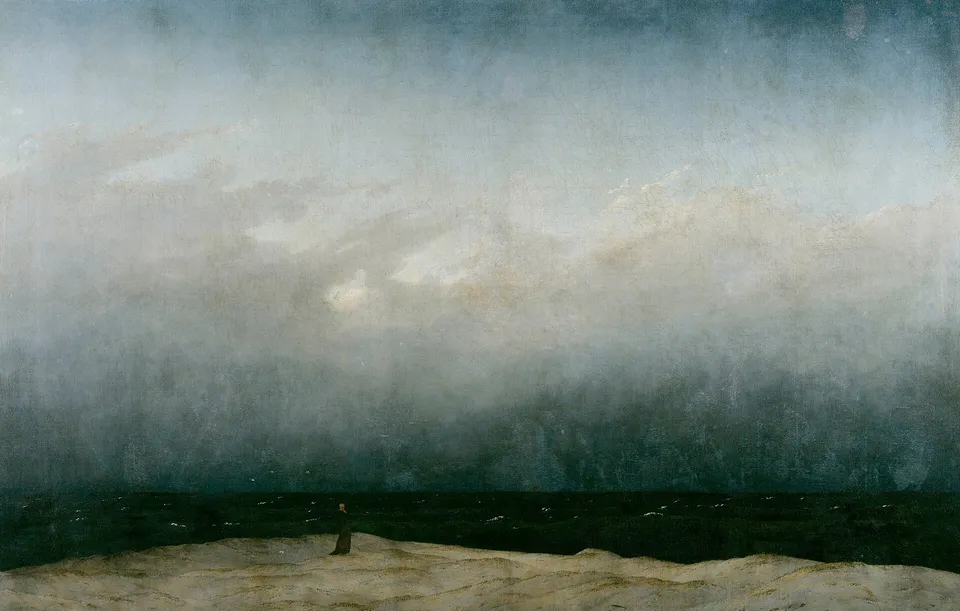
In 1810 it was exhibited at the Berlin Academy together with The Monk by the Sea, conceived as a pair. The fifteen-year-old Prussian crown prince was captivated, and King Frederick William III bought both.
Prussia had just been defeated by Napoleon and national morale was low; some scholars see the painting's desolation as reflecting that mood.
Technique & composition
The lower half sinks almost into darkness, while the sky above brightens from deep brown to pale yellow. The dead trees and stand silhouetted against it, creating an intensely solemn atmosphere.
The composition centres on of the ruin, flanked by roughly symmetrical like the columns of a nave, turning the whole wood into an open-air sanctuary.
Friedrich built up the sky in thin, translucent layers so that mist and twilight merge. Look closely and the figures of are tiny, stressing human insignificance before nature and time.
Details
Symbolism
Death and burial
The monks carry the coffin towards the ruined doorway; in the foreground is , and tombstones and crosses are scattered around. The whole painting is a funeral, perhaps the artist imagining his own.
Dead trees and ruins
The dead oaks and ruined abbey symbolise death, decay and the passing of old faith. In German culture the oak also stood for the nation, so their withering may hint at the country's plight.
The crescent moon and the light
A hangs in the sky, and light glows along the horizon. Above darkness and death, light remains, a hint of resurrection and eternal life.
Stories
- Did you know?
X-ray studies show that Friedrich originally painted more detail in the ruined doorway, later removing it to heighten the sense of emptiness.
- Did you know?
It hangs beside The Monk by the Sea in Berlin's Alte Nationalgalerie: one showing the solitude of the living before the sea, the other the peace of the dead returning to the earth.
- Did you know?
In 2024, the 250th anniversary of Friedrich's birth, several German museums staged major exhibitions, with this painting among the highlights.
Legacy
The Abbey in the Oakwood turned landscape into a vehicle for religious and philosophical reflection and is one of the most profound works of German Romanticism. It influenced later Symbolist painters and the gloomy Gothic settings of twentieth-century cinema.