A makeshift raft drifts on a raging sea, heaped with the dying and the dead; only at the top does one man still wave a cloth frantically towards a ship barely visible on the horizon. Géricault painted a shipwreck that scandalised France on a life-size scale, raising a contemporary scandal to the level of epic tragedy.
Key facts
- Artist
- Théodore Géricault1791–1824 · French
- Date
- 1818–19
- Period
- Romanticism1790–1850
- Medium
- Oil on canvas
- Dimensions
- 491 × 716 cm
- Location
- Musée du Louvre Paris, France
Actual size
Compared with an adult 170 cm tall
Palette
#1A100B#3D2E22#5A4B3C#7D6A58#AC9884Background
In July 1816 the French frigate Méduse ran aground off the coast of present-day Mauritania on its way to Senegal. Its captain, Viscount de Chaumareys, was an aristocrat who had hardly sailed in twenty years and owed his post to political connections. With too few lifeboats, some 150 people were put on a hastily built raft.
The lifeboats were supposed to tow the raft but soon cut the ropes and left it adrift. Over thirteen days those aboard endured starvation, thirst, mutiny, suicide and cannibalism; only fifteen were rescued by the brig Argus, and several of them died afterwards. The survivors' published account turned the disaster into a scandal exposing the incompetence of the restored Bourbon government.
The twenty-seven-year-old Géricault devoted over a year to the project: he interviewed survivors, had a carpenter build a scale model of the raft, observed dying patients in hospital, and brought body parts from the morgue to his studio to study decomposition.
Technique & composition
The composition is built on two pyramids: one on the left formed by and ropes, symbolising despair, and one on the right, a mound of bodies rising to , symbolising hope. The eye climbs from the corpses at lower left to the signaller at upper right.
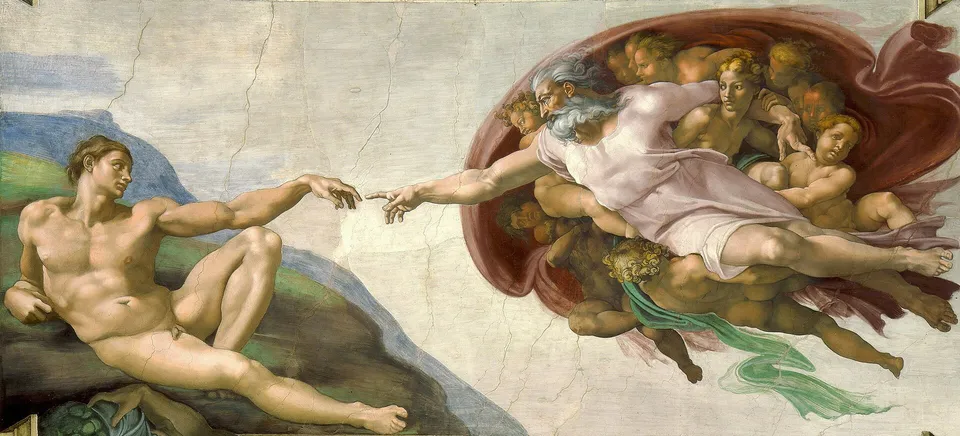
The figures have the heroic musculature of classical sculpture, recalling Michelangelo, while the sombre palette, dramatic chiaroscuro and vigorous handling are Romantic. Géricault used large amounts of bitumen to deepen the shadows; the unstable pigment has caused the surface to darken and crack.
The raft tilts towards us, and in the foreground almost slide out of the frame, placing the viewer at the edge of the raft, face to face with the disaster.
Details
Symbolism
Hope and despair
The painting captures the moment the survivors first sighted . But it is a mere speck on the horizon and, at that moment, did not see them. Hope and despair coexist, making the scene almost unbearable.
Father and son
On the left holds the body of his dead son, staring blankly into space, indifferent to rescue. The figure recalls Count Ugolino in Dante's Inferno, who devoured his children, a veiled reference to the cannibalism on the raft.
The Black signaller
At the apex, waving the cloth, is a Black man. At a time when the slave trade had not been abolished, Géricault placed him at the summit of hope, a choice many scholars read as a statement of support for abolition.
Stories
- Did you know?
The young Delacroix posed for the painting; the face-down figure with outstretched arm in the centre foreground is said to be modelled on him.
- Did you know?
To avoid offending the government, it was exhibited at the Salon of 1819 as Scene of a Shipwreck, but everyone knew what it depicted.
- Did you know?
Géricault shaved his head and shut himself away in his studio for eight months to avoid distractions.
Legacy
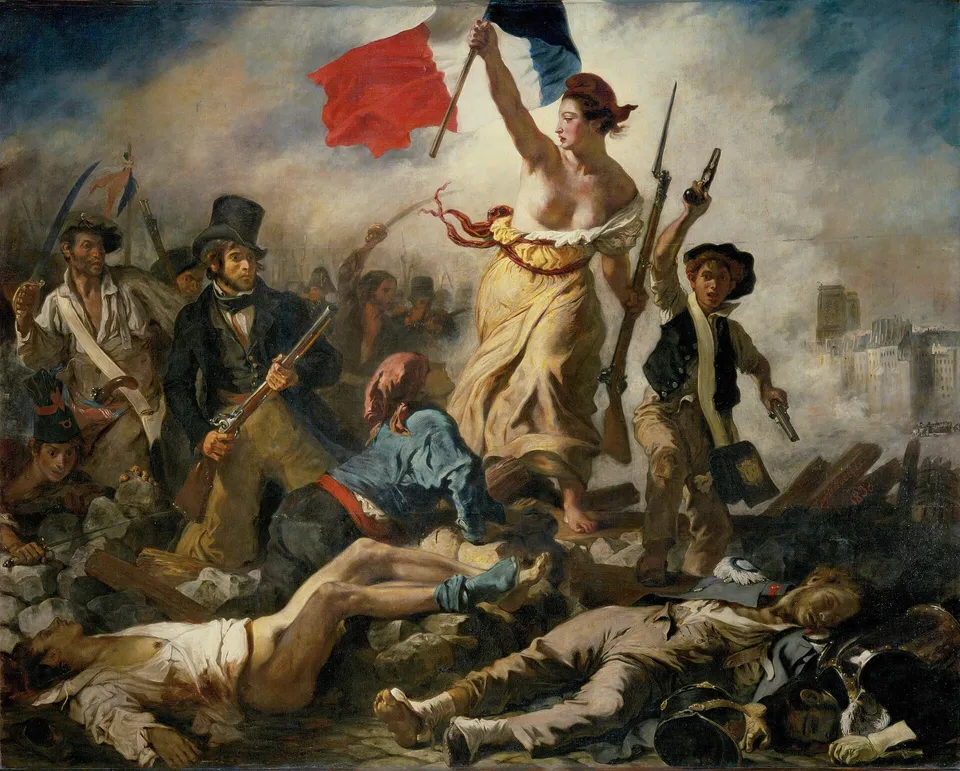
The Raft of the Medusa presented a contemporary news event on the scale of history painting, breaking the academic tradition of painting only ancient and mythological subjects. A founding work of Romanticism, it inspired Delacroix's Liberty Leading the People and later the Realists' engagement with contemporary society.
Today “the raft of the Medusa” has become a metaphor for disaster and abandonment, often invoked by contemporary artists responding to issues such as the refugee crisis.