On a summer afternoon an empty hay cart fords a stream in Suffolk, England, beside an old cottage, while farm workers make hay in the distant meadow. Constable painted his native countryside so truthfully that the clouds seem to move.
Key facts
- Artist
- John Constable1776–1837 · English
- Date
- 1821
- Period
- Romanticism1790–1850
- Medium
- Oil on canvas
- Dimensions
- 130.2 × 185.4 cm
- Location
- The National Gallery London, United Kingdom
Actual size
Compared with an adult 170 cm tall
Palette
#473B26#2F2517#878A89#645B46#19120ABackground
The scene is Flatford on the River Stour, where Constable's family owned a mill. The cottage on the left belonged to a farmer named Willy Lott, who is said to have spent hardly a night away from it in his whole life.
Constable painted the picture in his London studio, based on years of sketches made at home. He first made a full-size oil sketch, now in the Victoria and Albert Museum in London.
Shown at the Royal Academy in 1821 as Landscape: Noon, it received a lukewarm response. At the Paris Salon of 1824, however, it was a sensation and won a gold medal, making Constable famous in France before he was in England.
Technique & composition
Constable was passionate about skies, making many outdoor cloud studies noting date, time and wind direction. here are richly layered and shifting, evoking the changeable English summer weather.
He flecked the leaves and water with tiny touches of white and yellow to suggest glittering sunlight, which critics mocked as “Constable's snow”. This way of conveying light with broken touches later deeply influenced French painters.
The composition centres on , with dense trees and on the left and open meadows stretching into the distance on the right, a contrast of density and space, shade and light.
Details
Symbolism
An idealised countryside
The painting presents a harmonious, peaceful English countryside, yet rural England in the early nineteenth century was suffering poverty and unrest, and the Industrial Revolution was drawing labourers to the cities. In a sense Constable was painting a vanishing memory of childhood.
Work and nature
The cart is in the water perhaps to let the horses drink or to swell the wooden wheels so they stay tight. In beyond, workers are haymaking. People and nature coexist in harmony.
Stories
- Did you know?
Willy Lott's cottage still stands, looked after by the National Trust, and looks almost exactly as it does in the painting.
- Did you know?
Delacroix is said to have been so struck by the painting in Paris that he immediately repainted the sky in his Massacre at Chios.
- Did you know?
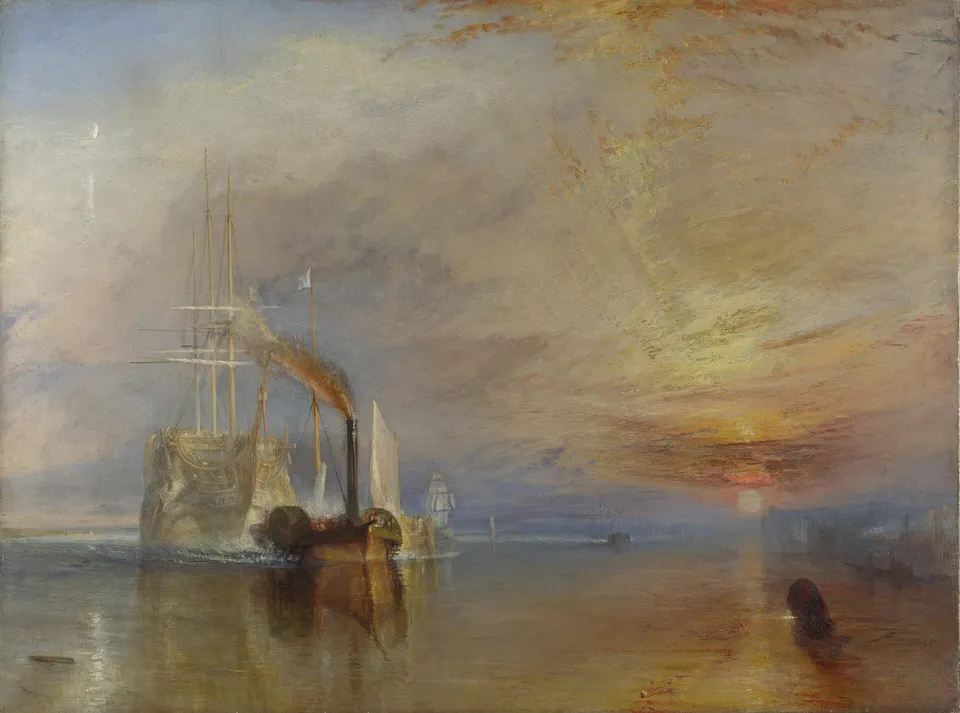
In a 2005 BBC poll, it came second only to Turner's Fighting Temeraire as the greatest painting in Britain.
Legacy
The Hay Wain secured Constable's place as one of Britain's greatest landscape painters. Its influence on the French Barbizon school and the Impressionists was profound; it is seen as a bridge between Romanticism, Realism and Impressionism.
Today it is the quintessential image of rural England, found on biscuit tins, calendars and postcards, a symbol of Englishness.