In the summer of 1889, in an asylum at Saint-Rémy in the south of France, Van Gogh painted the sky before dawn from memory and imagination. Its churning nebulae, flame-like cypress and sleeping village have made this canvas, less than a metre wide, one of the most recognised paintings in the world.
Key facts
- Artist
- Vincent van Gogh1853–1890 · Dutch
- Date
- June 1889
- Period
- Post-Impressionism1886–1905
- Medium
- Oil on canvas
- Dimensions
- 73.7 × 92.1 cm
- Location
- The Museum of Modern Art New York, United States
Actual size
Compared with an adult 170 cm tall
Palette
#1D2428#5C7390#40547B#303E55#7D93A4Background
In December 1888, after a violent quarrel with Gauguin in Arles, Van Gogh suffered a breakdown and cut off his left ear. His condition fluctuated for months, and some townspeople even petitioned to have him removed. In May 1889 he voluntarily admitted himself to the asylum of Saint-Paul-de-Mausole at nearby Saint-Rémy, where he would stay for a year.
The asylum gave him two rooms: a bedroom and a ground-floor studio. The barred bedroom window faced east over a walled wheat field towards the Alpilles hills. Van Gogh painted that view more than twenty times, in different seasons and at different hours; The Starry Night is the only night scene among them.
He was not allowed to paint in his bedroom at night, so the picture was made by day in the studio, from memory. In early June 1889 he wrote to his brother Theo: “This morning I saw the countryside from my window a long time before sunrise, with nothing but the morning star, which looked very big.” Astronomers have since confirmed that Venus was indeed shining brightly in the eastern sky before dawn at that time.
Yet the painting is no faithful record of the view. The village cannot be seen from the bedroom window at all; the town and its church are imagined. The cypress has been moved closer and enlarged, and the moon is shown as a crescent, although at the time it was nearly full. Van Gogh fused observation, memory and feeling into an inner night sky.
Technique & composition
There is hardly a flat area anywhere in The Starry Night. Van Gogh laid down short, directional strokes one after another, arranging them into flowing lines; every eddy in the sky is made of dozens of parallel ribbons of colour. The paint is thick, a classic , and raking light reveals pronounced ridges.
For colour, he built the night from and cobalt blue, then painted the halos of stars and moon in chrome yellow, lemon yellow and white. Blue and yellow are near ; side by side they intensify each other, so the starlight seems to vibrate. The near-black green of the cypress and the deep blue hills give the picture a grounding weight.
The composition is built on the contrast of horizontal and vertical. The sky takes up about three-quarters of the canvas, with sweeping from left to right; and village rooftops continue this horizontal rhythm. The in the left foreground and the are two verticals that tie earth to sky.
Van Gogh outlined the hills and houses in dark contours and treated the halos as flattened shapes, devices inspired by Japanese prints and by the he encountered in Paris. For all its agitation, the picture is carefully structured.
Details
Symbolism
The cypress: between life and death
Around the Mediterranean, cypresses are planted in cemeteries and associated with death and mourning. Van Gogh, though, called them “beautiful as an Egyptian obelisk”. Here the tree rises like a flame into the stars, a bridge between earth and heaven, life and eternity.
The stars: a journey after death
In 1888 Van Gogh wrote: “Looking at the stars always makes me dream… Just as we take the train to get to Tarascon or Rouen, we take death to reach a star.” The eleven enormous stars may carry his hopes of consolation and of a world beyond death.
The steeple: a memory of home
The tall, slender spire looks less like a Provençal church than a village church in North Brabant, in the Netherlands. Many scholars read it as Van Gogh's longing, ill and far from home, for his homeland and childhood.
The swirl: cosmic energy
The churning spiral reads as wind and as nebula; some suggest a link with astronomical illustrations popular at the time. Whatever its source, it expresses an energy beyond what the eye can see: the cosmos in motion, and the painter's inner turmoil with it.
The village: the sleeping world
Beside the frenzy of the sky, the village is small and still, its windows glowing with warm light. The calm of human life set against the immensity of the cosmos makes the viewer feel their own smallness between earth and sky.
Stories
- Did you know?
Van Gogh himself was not especially pleased with the painting. Writing to his friend the painter Émile Bernard, he said he had let himself paint “stars that are too big”, calling it “a new setback”. When Theo received it, he admitted he felt his brother's search for style had overtaken real feeling.
- Did you know?
Physicists who analysed the distribution of light and dark in the swirls found that it closely matches Kolmogorov's statistical theory of turbulence in fluid dynamics. Van Gogh knew nothing of the mathematics, yet intuitively painted something very like real turbulence.
- Did you know?
Van Gogh sold very few works in his lifetime. After his death The Starry Night stayed with his family, then passed through several hands until the Museum of Modern Art in New York acquired it in 1941. It remains the museum's most popular work.
- Did you know?
In 1971 the American singer Don McLean wrote the song “Vincent”, inspired by the painting. Its opening line, “Starry, starry night”, carried the picture's name deep into popular culture.
- Did you know?
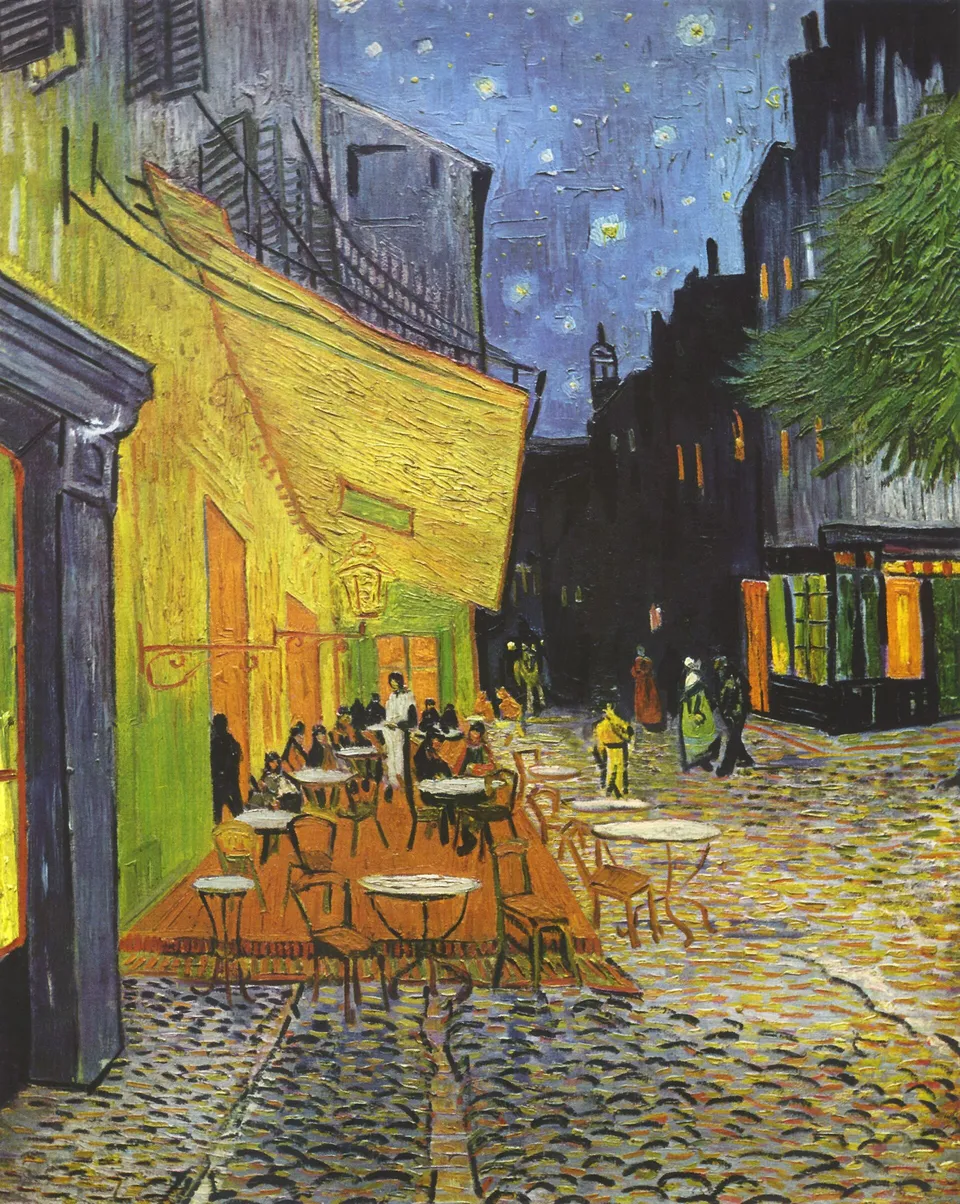
In Arles, Van Gogh had already painted two starry skies: Café Terrace at Night and Starry Night Over the Rhône. Both were painted from the motif; The Starry Night alone was made from imagination, which is part of what makes it unique.
Legacy
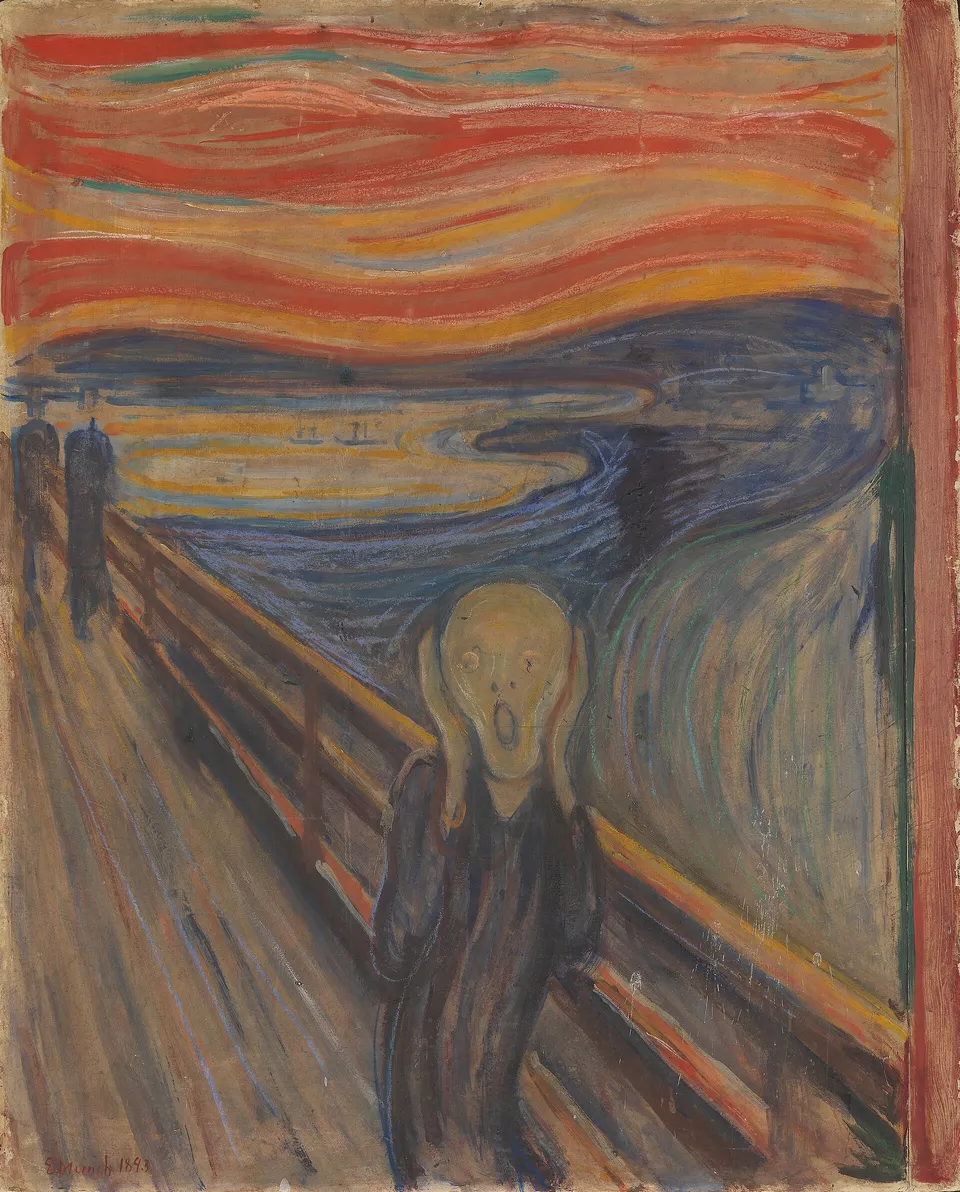
Van Gogh's use of distorted form and subjective colour to convey emotion led directly to early twentieth-century . The painters of Die Brücke and the Blue Rider, as well as Munch and Kandinsky, found in his work proof that painting could express the inner life.
Today The Starry Night has long outgrown the museum. It appears in films, television, music, advertising and countless souvenirs; it inspired Loving Vincent, a feature film made entirely of hand-painted oil frames, and immersive projection exhibitions around the world. It has even become a brick-built model, and for many people it is the first Western painting they ever get to know.
Its fame has also fed the romantic myth of the “suffering genius”. Van Gogh's letters, however, reveal a thoughtful, widely read painter who studied colour theory in depth. When looking at The Starry Night, it is worth seeing it as the work of a lucid, hard-working artist searching for beauty and hope in the midst of hardship.