Under a blood-red sunset, with a typhoon coming on, a slave ship pitches in a raging sea as its crew throws the dead and dying overboard; in the foreground waves we glimpse shackles, a leg raised above the water and fish swarming to feed. Turner fused the violence of nature with the cruelty of man in one of the most shocking and accusatory works of his late career.
Key facts
- Artist
- J. M. W. Turner1775–1851 · English
- Date
- 1840
- Period
- Romanticism1790–1850
- Medium
- Oil on canvas
- Dimensions
- 90.8 × 122.6 cm
- Location
- Museum of Fine Arts, Boston Boston, United States
Actual size
Compared with an adult 170 cm tall
Palette
#D2BF9A#A18357#533D24#885A32#77654CBackground
Its original title was Slavers throwing overboard the Dead and Dying — Typhoon coming on. It draws on the Zong massacre of 1781, when the captain of the British slave ship Zong, claiming a shortage of water, threw more than 130 captive Africans into the sea and then claimed for the “lost cargo” on insurance.
Britain had abolished slavery in its colonies in 1833, but the trade continued elsewhere. In 1839 the abolitionist Thomas Clarkson reissued his account that included the Zong; the next year London hosted the first World Anti-Slavery Convention, and that was the year Turner sent this picture to the Royal Academy.
He exhibited it with lines from his own poem Fallacies of Hope: “Before it sweeps your decks, throw overboard / The dead and dying — ne'er heed their chains. / Hope, Hope, fallacious Hope! / Where is thy market now?”
Technique & composition
The true protagonists are light and colour. bursts in blood-red and gold between sea and sky, burning outward from the centre, while announce the typhoon. Turner used paint thick and thin, scraped and glazed, so that the sky seems to tremble.
is pushed into the distance, its masts heeling in the gale, little more than a silhouette. The eye is drawn instead to the foreground: among , only on closer looking do we find , and fish and gulls tearing at the bodies. The horror does not strike at once; it surfaces slowly.
Details
Symbolism
Nature's judgement
The approaching typhoon can be read as heaven's punishment: the crew who cast people overboard for insurance money are themselves about to be engulfed. Human injustice and nature's wrath answer each other.
A sea of blood
The sunset stains the whole sea red — a natural effect that also suggests the blood of the murdered. The clash between beautiful colour and appalling subject leaves the viewer uneasy after the first gasp of admiration.
The chains
Even in the sea the victims remain in chains. These irons are the most concrete and chilling details in the picture, reminding us that slavery reduced people to cargo.
Stories
- Did you know?
The critic John Ruskin's father gave him this painting as a New Year's present in 1844. Ruskin called it Turner's greatest seascape, but later found the subject too painful to live with and sold it.
- Did you know?
Mark Twain mocked it as looking like “a tortoise-shell cat having a fit in a platter of tomatoes”. Many at the time could not accept Turner's almost abstract late style.
- Did you know?
After changing hands several times, it was bought in 1876 by the Boston collector Alice Hooper and has been in the Museum of Fine Arts, Boston, since 1899.
Legacy
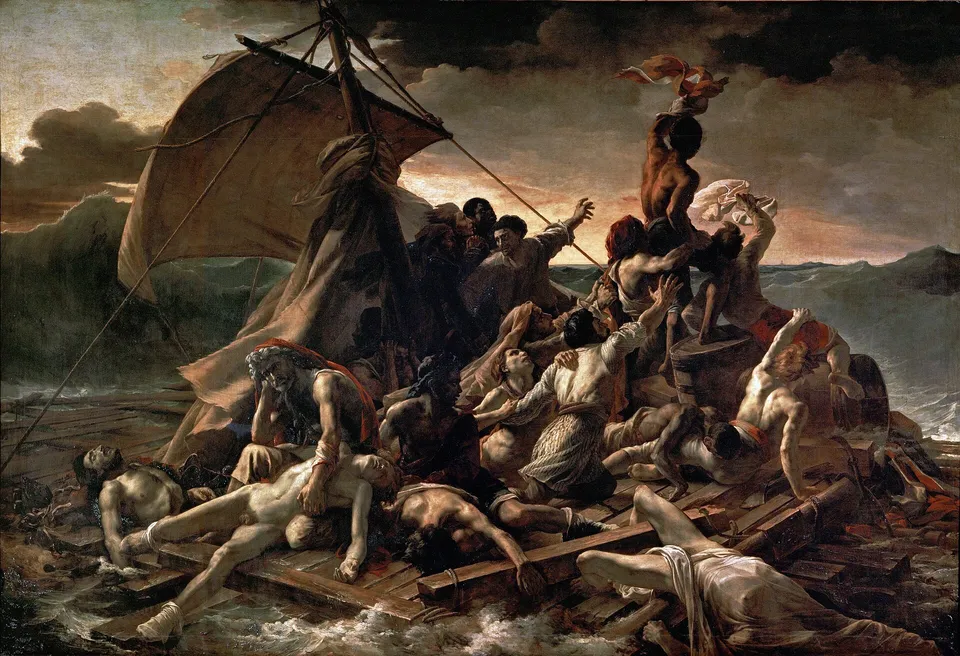
The Slave Ship is seen as a pioneer of art engaging with social injustice, often compared with Géricault's Raft of the Medusa. Its colour and brushwork anticipate Impressionism and Abstract Expressionism, and today it is one of the images most often invoked in reckoning with the history of the slave trade.