A steam train hurtles towards us across a railway bridge over the Thames in driving rain. The whole world dissolves into rain, mist and light; only the black locomotive stands out. With an almost abstract technique, Turner captured the speed and power of the industrial age.
Key facts
- Artist
- J. M. W. Turner1775–1851 · English
- Date
- 1844
- Period
- Romanticism1790–1850
- Medium
- Oil on canvas
- Dimensions
- 91 × 121.8 cm
- Location
- The National Gallery London, United Kingdom
Actual size
Compared with an adult 170 cm tall
Palette
#B1AB96#A19A82#908365#756444#493723Background
Its full title is Rain, Steam and Speed – The Great Western Railway. The Great Western, engineered by Isambard Kingdom Brunel, linked London with the west of England; the Maidenhead Railway Bridge shown here, completed in 1838, had the flattest, widest brick arches in the world at the time.
Britain in the 1840s was in the grip of “railway mania”; trains were transforming people's sense of time and space at unprecedented speed. Turner, approaching seventy, was fascinated by the new technology.
When shown at the Royal Academy in 1844, some critics marvelled and others mocked its apparent formlessness. The novelist Thackeray wrote that the world had never seen anything like it.
Technique & composition
Turner used broad washes of thin colour and scraped strokes to evoke rain and mist, so that sky, river and fields almost merge. Only and the bridge are painted dark, forming a powerful diagonal that rushes from the distance straight at the viewer.
of the engine glows red, the hottest colour in the picture, a symbol of the energy that drives the machine. This pure pursuit of light and colour makes Turner a forerunner of Impressionism and even abstraction.
Details
Symbolism
The running hare
On the track ahead of the train runs , now barely visible because the paint has faded. The hare is one of nature's fastest creatures, yet the train is about to overtake it. Is this a celebration of progress or a lament for nature being overtaken? Turner leaves the question open.
Old and new
On the left stands the old ; on the river below floats , and a farmer ploughs in the fields. The traditional rhythm of life and the roaring train share the same picture, recording a turning point in history.
Stories
- Did you know?
A woman later claimed that she had shared a train compartment during a storm with an elderly gentleman who put his head out of the window for nearly nine minutes; a year later she saw this painting and realised he was Turner. The story is famous but unverifiable.
- Did you know?
The Maidenhead Railway Bridge is still in use today, with trains crossing it every day.
Legacy
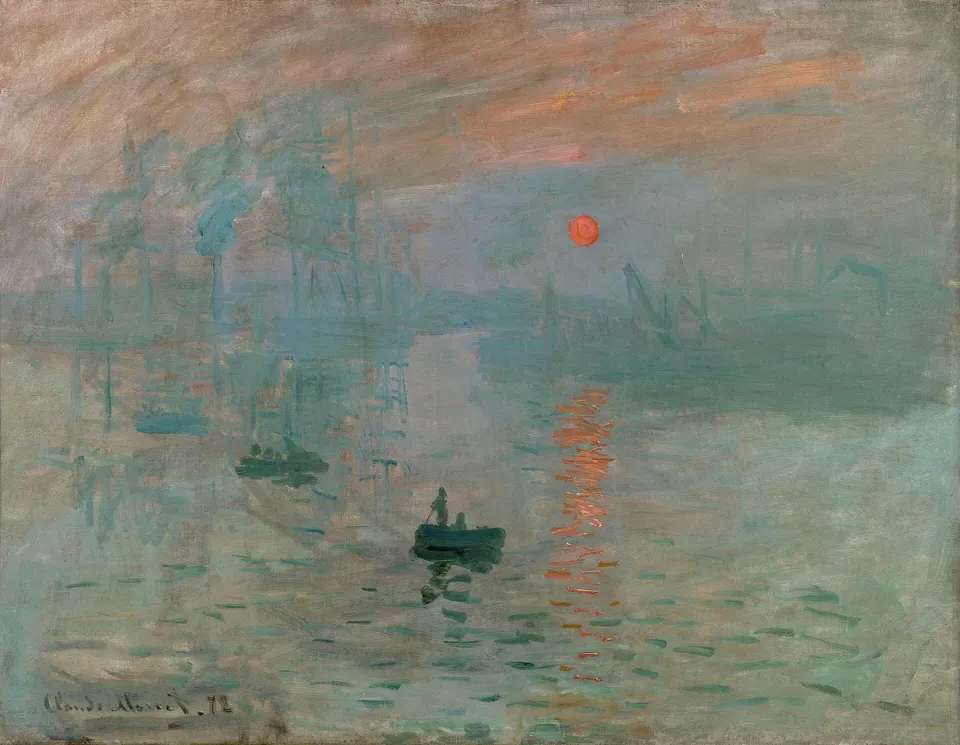
Rain, Steam and Speed is one of the first great paintings about modern technology. Monet and Pissarro were inspired by Turner's work in London; Monet later painted a series of the Gare Saint-Lazare, continuing the exploration of steam and light.
The Futurists of the twentieth century, who glorified speed and machines, have been seen as continuing the theme this painting opened.