Greek civilians await their fate on a barren shore: some are dying, some cling to each other, some stare blankly at the sky; at the right an Ottoman horseman rides in, dragging away a bound woman. With this huge canvas the twenty-six-year-old Delacroix depicted a massacre only two years old, shaking the Paris Salon of 1824 and firing the opening shot of Romanticism.
Key facts
- Artist
- Eugène Delacroix1798–1863 · French
- Date
- 1824
- Period
- Romanticism1790–1850
- Medium
- Oil on canvas
- Dimensions
- 419 × 354 cm
- Location
- Musée du Louvre Paris, France
Actual size
Compared with an adult 170 cm tall
Palette
#858C94#ACADAE#746E6E#3E3532#1B1515Background
In 1821 the Greeks rose up against Ottoman rule. In April 1822 Ottoman troops landed on the Aegean island of Chios to crush the revolt; tens of thousands of inhabitants were killed and many more carried off into slavery. The news caused outrage across Europe.
European intellectuals widely sympathised with the Greeks, seeing Greece as the cradle of Western civilisation. The English poet Byron went to fight for the Greek cause and died of fever at Missolonghi in April 1824 — the very year this painting was exhibited.
After the 1824 Salon the French state bought the painting for six thousand francs and hung it in the Musée du Luxembourg; it later moved to the Louvre.
Technique & composition
There is no single hero or focal point. The victims are spread across the foreground in two loose pyramids: at the left and huddled families; at the right , , and with . Between them lies an empty gap, and beyond, .
Delacroix painted with rich colour and free brushwork; skin, cloth and sky shimmer with small touches of colour. It is said that before the Salon opened he saw Constable's The Hay Wain, was deeply struck, and reworked the sky and background to make the colour brighter and more luminous.
Details
Symbolism
Anonymous victims
Traditional history painting celebrated heroes and victories; this picture has no hero, only helpless civilians. Delacroix put suffering itself at the centre, forcing viewers to face what war does to ordinary people.
The old woman's gaze
The old woman sits beside the dead, staring emptily at the sky, beyond tears. She stands for those who have lived through everything and no longer hope for anything — one of the most heartbreaking figures in the painting.
An Orientalist vision
The splendid Ottoman costume, horse and weapons reflect Europe's Romantic fantasy of the “Orient”, making this an early example of . Modern critics also note that it casts the Ottomans uniformly as brutal aggressors, a clearly partisan view.
Stories
- Did you know?
The Neoclassical painter Gros called it “the massacre of painting”. Meant as a criticism, the phrase became a famous slogan for Romanticism's break with classical rules.
- Did you know?
It was shown at the same Salon as Ingres's The Vow of Louis XIII, and from then on the two painters were seen as leaders of the rival camps of colour and line.
- Did you know?
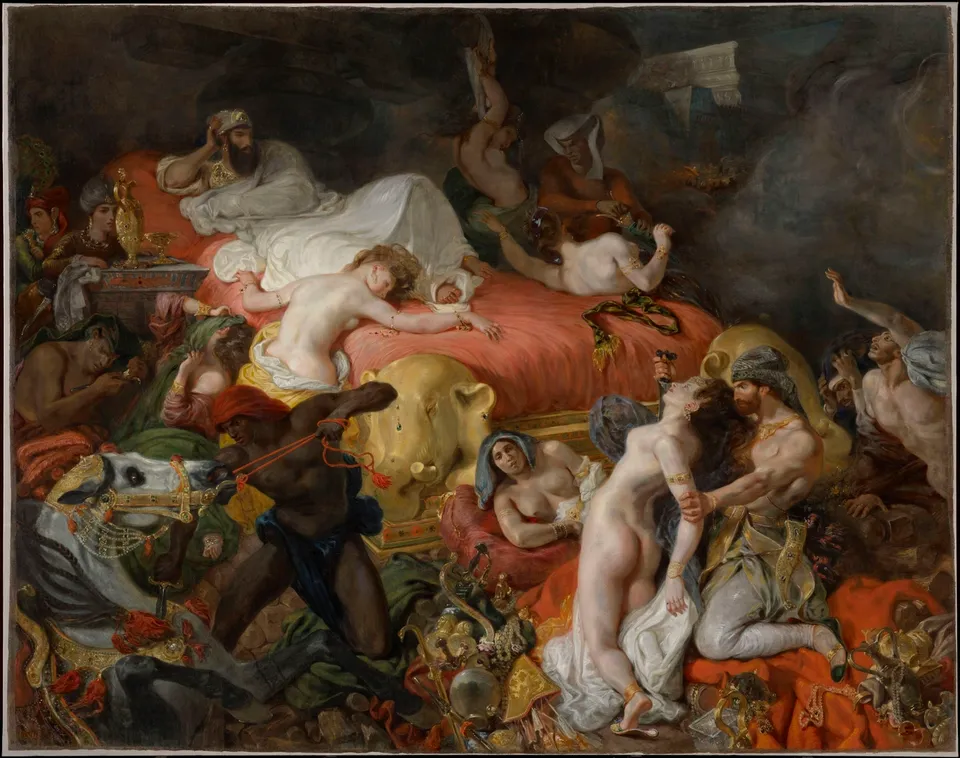
Three years later Delacroix shocked the Salon again with The Death of Sardanapalus, which he jokingly called his “Massacre No. 2”.
Legacy
The Massacre at Chios established Delacroix as the leader of French Romanticism and showed that painting could respond directly to contemporary world events. It helped sway European opinion in favour of the Greek cause; Greece's independence was finally recognised in 1830.