A nude woman reclines on white sheets, roses in her hand, meeting our gaze without a trace of shyness; a little dog sleeps curled at her feet, and behind her two maids search a great chest for clothes. Titian brought the goddess out of the mythical landscape and into a real Venetian bedroom, creating one of the most influential nudes in Western art.
Key facts
- Artist
- Titian1490–1576 · Italian
- Date
- c. 1534–1538
- Period
- Renaissance1400–1520
- Medium
- Oil on canvas
- Dimensions
- 119 × 165 cm
- Location
- Uffizi Gallery Florence, Italy
Actual size
Compared with an adult 170 cm tall
Palette
#0E080B#3F1C15#D9B68C#F5E6D0#6C3F2ABackground
The painting seems to have been largely finished by about 1534 but stayed in Titian's studio. In 1538 the young Guidobaldo II della Rovere, sitting to Titian for his portrait, set his heart on it, and his letters show him anxious to buy “the nude woman”. That same year he inherited the Duchy of Urbino, which gave the picture its name.
The pose comes from the Sleeping Venus by Titian's elder colleague Giorgione; Giorgione died young, and the landscape of that picture is said to have been finished by the young Titian. But where Giorgione's Venus sleeps with closed eyes in the open air, Titian's is awake, and indoors.
In 1633 it passed to the Medici when Vittoria della Rovere, the last of her line, married Ferdinando II de' Medici, Grand Duke of Tuscany. It moved to the Uffizi in 1736 and has been there ever since.
Technique & composition
Titian built up the warm, soft flesh in many translucent layers of oil, set against cool white sheets and a deep red mattress. This is the essence of Venetian : form modelled not by outline but by colour and light.
splits the picture in two: on the left the intimate nude close to us, on the right the deep room and the busy maids. The screen's edge falls at the exact centre, drawing the eye down to .
Details
Symbolism
An allegory of marriage
Many scholars see a picture about marriage: stands for fidelity, is a cassone, the wedding chest in which brides kept their trousseau, and is a symbol of Venus and of faithfulness in marriage.
Goddess or woman?
There is no Cupid and no seashell; apart from and the myrtle there is hardly any sign of a goddess. , frank and intimate, leaves us wondering whether she is Venus, a bride or a real woman.
Stories
- Did you know?
In 1880 the American writer Mark Twain, in his travel book A Tramp Abroad, called it “the vilest, the obscenest picture the world possesses”, while admitting it was a masterpiece. His remark reflects the Victorian age's uneasy attitude to the nude.
- Did you know?
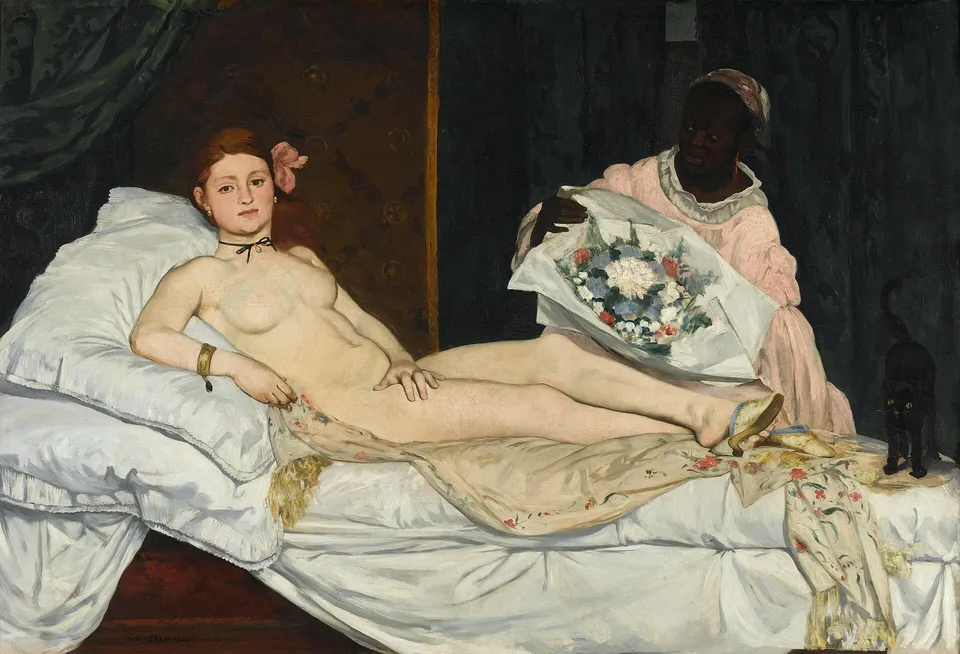
The young Manet copied this painting in the Uffizi. In 1863 he turned the same composition into Olympia: the goddess became a Parisian prostitute, and the sleeping dog a black cat with its tail raised.
Legacy
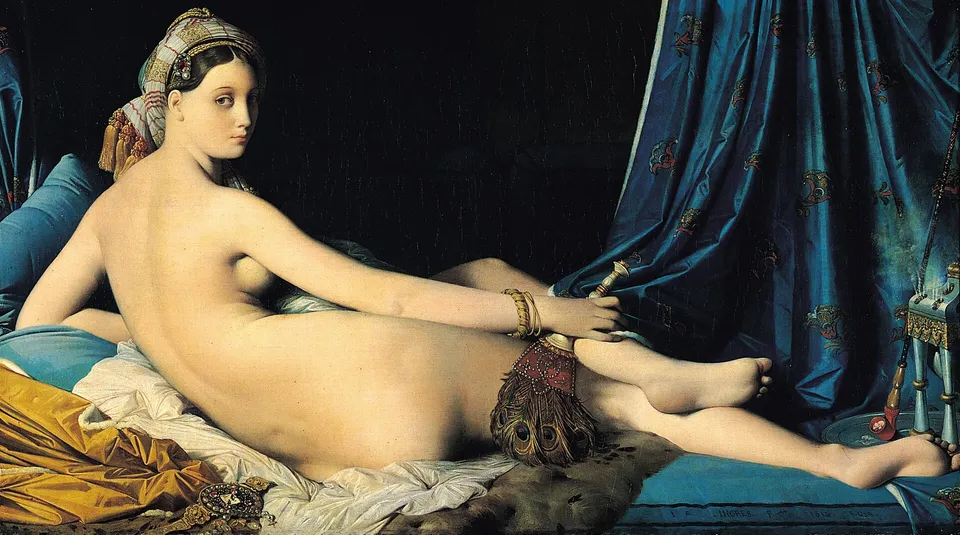
Venus of Urbino established the reclining nude as a central theme of Western art; its echo can be seen from Velázquez's Rokeby Venus and Goya's Naked Maja to Ingres's Grande Odalisque and Manet's Olympia.