Venus, goddess of love and beauty, rises from the sea and is blown ashore on a scallop shell by the west wind. It was the first life-size mythological nude since antiquity, a landmark of the Renaissance embrace of the classical world.
Key facts
- Artist
- Sandro Botticelli1445–1510 · Italian
- Date
- c. 1484–86
- Period
- Renaissance1400–1520
- Medium
- Tempera on canvas
- Dimensions
- 172.5 × 278.9 cm
- Location
- Uffizi Gallery Florence, Italy
Actual size
Compared with an adult 170 cm tall
Palette
#CBC09A#B3A078#917C58#E3DCBF#655536Background
In the 1480s Florence, under the Medici, was the centre of humanism. Scholars such as Marsilio Ficino translated Plato and tried to reconcile classical philosophy with Christian faith, so Greek and Roman myths were no longer forbidden paganism but allegories for exploring beauty and love.
Who commissioned the painting is uncertain; it is generally linked to a junior branch of the Medici family. In the mid-sixteenth century the painter and biographer Giorgio Vasari recorded it at the Medici villa at Castello. The subject comes from ancient Greek poetry: Venus was born from the foam of the sea and carried by the winds to Cyprus or Cythera.
In 1497 the friar Savonarola led the “Bonfire of the Vanities” in Florence, burning books and pictures deemed immoral. The painting may have survived only because it hung in a private villa outside the city.
Technique & composition
Botticelli painted in , but unusually on canvas rather than panel. Canvas was lighter and easier to move between villas; he also mixed a little gesso into the paint, giving it a matt, fresco-like clarity.
The picture favours line over volume. is outlined with calligraphic fluency; her neck is elongated and her shoulders slope, her left arm is anatomically improbable, and her stance could hardly bear her weight. These “errors” are deliberate: Botticelli was after ideal grace, not anatomical realism.
Venus forms the central axis, balanced by on the left and on the right in a shallow triangle. The waves are regular V-shaped marks, more pattern than water. Gold highlights touch , the hair and the wings, which would have glimmered in candlelight.
Details
Symbolism
Heavenly love
In Neoplatonic thought there were two Venuses: earthly love and heavenly love. This motherless Venus born from the sea stands for the latter, a pure, divine beauty that leads the soul from the material towards the divine.
Shell and roses
The scallop shell was associated since antiquity with fertility and birth. Roses, said to have come into being at the same moment as Venus, float down around her; their thorns remind us that love can wound.
The modest pose
One hand over her breast and the other drawing her hair across her body, Venus adopts the classical Venus Pudica, or “modest Venus”, pose. Botticelli knew such statues from Medici collections and turned stone into a living goddess.
The orange trees
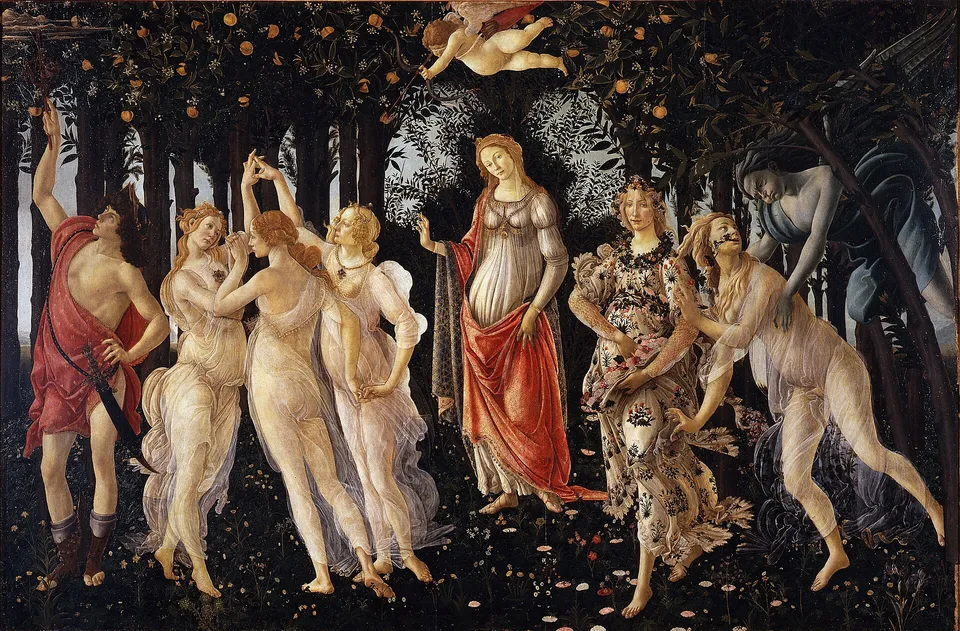
The trees on the right shore are usually identified as orange trees. In Latin oranges were called mala medica, a pun on the Medici name, so they may allude to the patrons, as in Primavera.
Stories
- Did you know?
A popular story says the model for Venus was the Florentine beauty Simonetta Vespucci. She had died in 1476, however, and no document supports the claim; it is more likely a nineteenth-century romantic invention.
- Did you know?
The Italian 10-cent euro coin bears the head of Botticelli's Venus.
- Did you know?
Botticelli was largely forgotten after his death. Only when the English Pre-Raphaelites and critics championed him in the nineteenth century did the painting become one of the Uffizi's most popular works.
Legacy
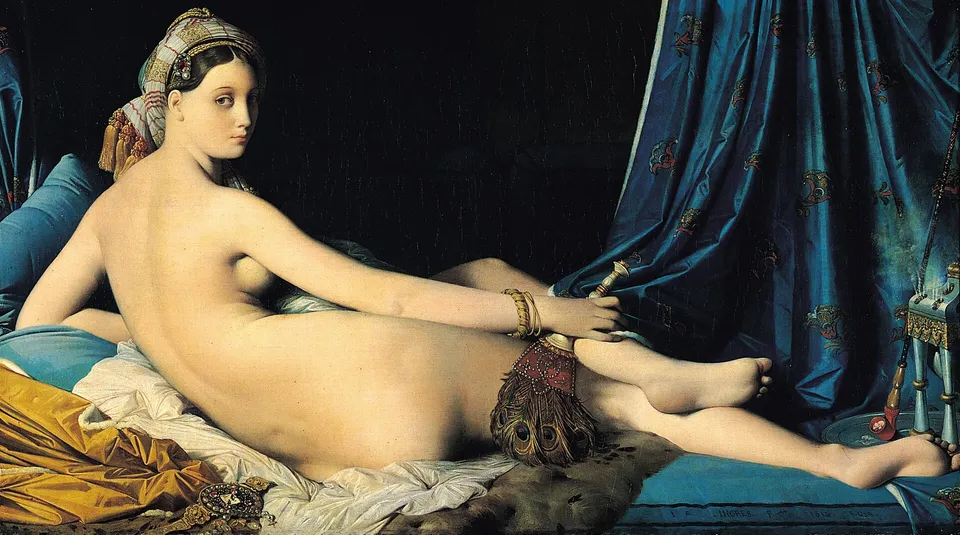
The Birth of Venus showed that pagan myth and the nude could be serious subjects for art, opening the way for the female nudes of Titian, Rubens and, much later, Ingres.
In modern times it is one of the most imitated and parodied paintings of all: Andy Warhol reworked a detail in silkscreen, and countless advertisements, fashion shoots and films have quoted Venus on her shell.