A Florentine merchant's wife sits with folded hands and a smile that seems to come and go. Leonardo reworked this small portrait for more than a decade, took it to France, and never delivered it. It is the most famous and most visited painting in the world.
Key facts
- Artist
- Leonardo da Vinci1452–1519 · Italian
- Date
- c. 1503–19
- Period
- Renaissance1400–1520
- Medium
- Oil on poplar panel
- Dimensions
- 77 × 53 cm
- Location
- Musée du Louvre Paris, France
Actual size
Compared with an adult 170 cm tall
Palette
#1A0E1E#392527#878351#555840#6D4829Background
The sitter is generally identified as Lisa Gherardini, wife of the Florentine silk merchant Francesco del Giocondo, which is why Italians call the painting La Gioconda. In 2005 a scholar found a marginal note of 1503 in a book at Heidelberg University Library confirming that Leonardo was then painting Lisa's portrait.
Leonardo never handed it over. He carried the portrait with him to Milan and Rome and finally to France, at the invitation of King Francis I, still retouching it in his last years. After his death it entered the French royal collection, hung at Fontainebleau and Versailles, and moved to the Louvre after the Revolution.
It was not always the world's most famous painting. What made it a household name was the 1911 theft: the Italian workman Vincenzo Peruggia walked out of the Louvre with it under his smock and was caught two years later trying to sell it in Florence. The global press coverage turned the Mona Lisa into the first international celebrity painting.
Technique & composition
Its most celebrated technique is . Leonardo applied dozens of extremely thin, translucent layers so that contours and shadows melt like smoke, without a single hard line. The corners of and dissolve into soft shadow, which makes the expression so elusive.
The figure sits in a stable , with her as its base. Behind her stretches a fantastical landscape painted with : the further away, the bluer and hazier it becomes, suggesting infinite depth.
Look closely at the background: the on the left is noticeably lower than on the right. The mismatch makes the figure seem subtly alive; as the eye moves from left to right, she seems to rise and her expression to shift.
Details
Symbolism
The enigmatic smile
Neuroscientists point out that peripheral vision is more sensitive to soft shadows. When we look at her eyes, the shadows at the corners of her mouth make her seem to smile; when we look straight at her mouth, the smile fades. This flickering effect is the work of sfumato.
Humanity and nature
The winding roads, rivers and in the background echo the curves of her drapery and hair. Leonardo believed the human body was a microcosm of the universe, its veins like rivers, so figure and landscape become one.
A respectable wife
Her dress is plain, without jewellery; a fine veil covers her hair; her right hand rests lightly on her left. All were conventions of portraits of respectable married women, signifying modesty and virtue.
Stories
- Did you know?
She has no eyebrows or eyelashes. Some say this was the fashion of the time; others that they were cleaned away long ago. The engineer Pascal Cotte claimed high-resolution scans revealed traces of an eyebrow.
- Did you know?
During the 1911 theft, Picasso was questioned by police and the poet Guillaume Apollinaire was briefly jailed; both were cleared.
- Did you know?
Since 2005 it has had a wall of its own in the Louvre's Salle des États, behind bulletproof glass. It has survived attacks with paint, cake and soup without damage.
- Did you know?
It is smaller than many people expect: only 77 × 53 cm, about the size of a large poster.
Legacy
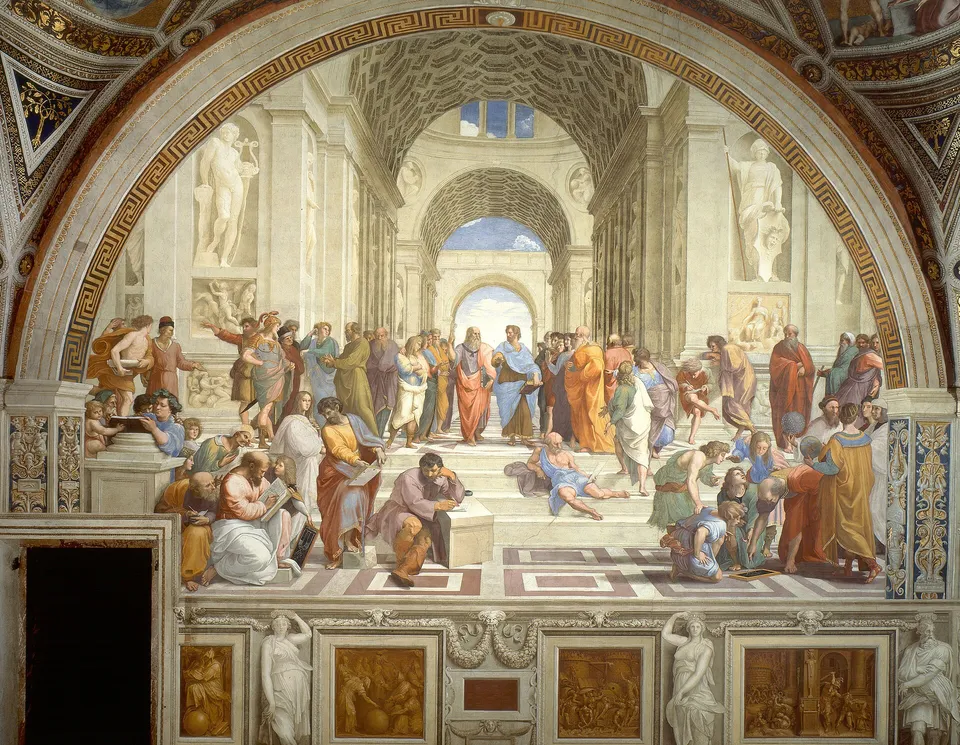
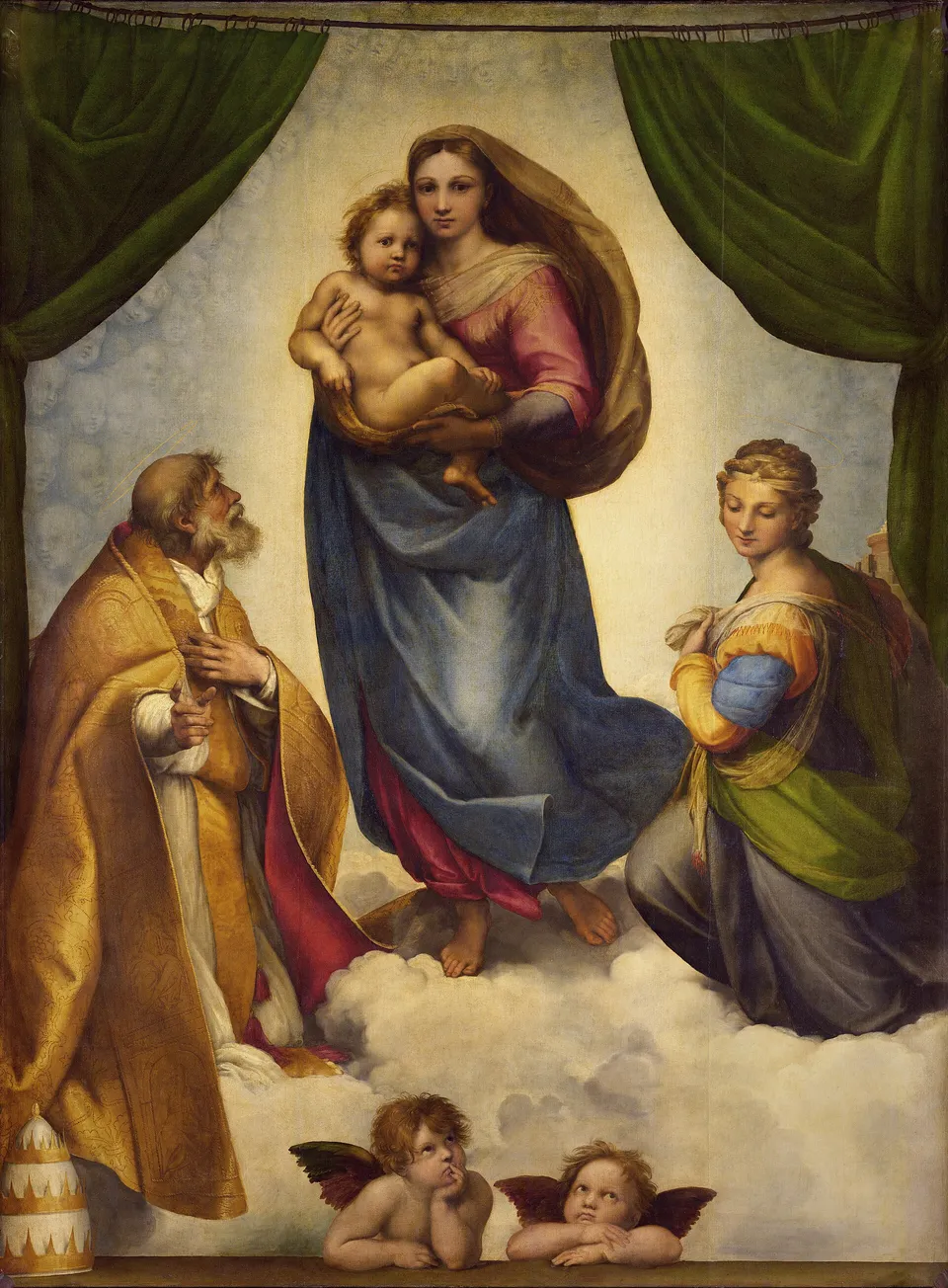
The Mona Lisa established a new model for portraiture: half-length, three-quarter view, with the hands included and a landscape behind. Raphael adopted the format almost at once, and portrait painters for centuries followed.
In the twentieth century she became a pop-culture icon. Duchamp drew a moustache on a postcard of her, Warhol multiplied her in silkscreen, and countless adverts and parodies have borrowed her image. She has become shorthand for the very idea of a masterpiece.