In a grove heavy with golden oranges, nine mythological figures enact the arrival of spring from right to left. Primavera is one of the most famous and most enigmatic paintings in Western art, and hundreds of plant species can be identified in it.
Key facts
- Artist
- Sandro Botticelli1445–1510 · Italian
- Date
- c. 1477–82
- Period
- Renaissance1400–1520
- Medium
- Tempera on panel
- Dimensions
- 202 × 314 cm
- Location
- Uffizi Gallery Florence, Italy
Actual size
Compared with an adult 170 cm tall
Palette
#221A1A#8B6F5B#654A3C#3D2F2A#C0A78BBackground
This huge panel originally hung in the Florentine town house of Lorenzo di Pierfrancesco de' Medici, from a junior branch of the Medici family. Some scholars link it to his wedding in 1482, which would suit its celebration of love, marriage and fertility.
Its imagery draws on the Roman poet Ovid's Fasti and on Lucretius and other classical writers, reflecting the passion for ancient literature among the humanists of the Medici circle. The artist left no explanation, however, and scholars have proposed countless readings over five centuries.
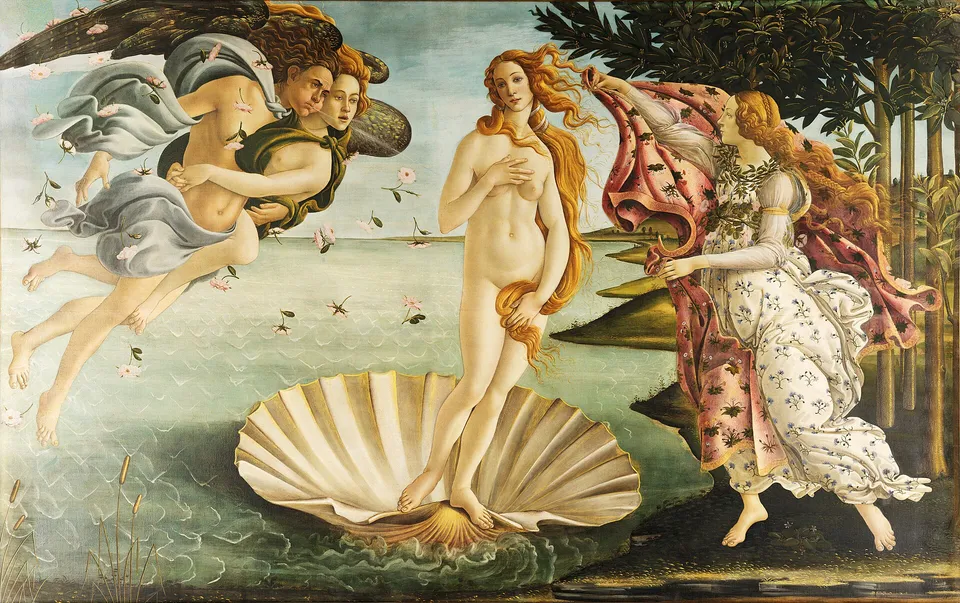
Primavera and The Birth of Venus were not made as a pair, but both treat pagan myth, both are by Botticelli, and both entered the Uffizi in the nineteenth century, where they now hang in the same room.
Technique & composition
The picture reads like a tapestry: the figures stand in a frieze with almost no depth between them, set off by the dark trees like a stage backdrop. This flattened treatment recalls the Northern tapestries so fashionable in Florence at the time.
The plants are rendered with extraordinary care. Botanists have identified around five hundred plant species in the meadow, some 190 of them in flower, most of which grow in the countryside around Florence in spring. The flowers on dress are especially exquisite.
The veils of are so sheer they almost vanish; Botticelli laid the faintest white over the flesh tones to suggest floating gauze. The figures' movements link like a dance, drawing the eye from right to left.
Details
Symbolism
A story from right to left
On the right, , seizes the nymph Chloris; flowers spill from her mouth as she is transformed into , who scatters roses on the earth. The metamorphosis comes from Ovid and signifies the spring wind bringing the world back to life.
Venus and Cupid
Venus stands at the centre before an arch of foliage, almost like the Virgin in a shrine. Above her, a blindfolded aims his arrow at random, a reminder that love is blind.
The Three Graces
The three dancing goddesses are often read as Chastity, Beauty and Pleasure. Cupid's arrow is aimed at the central one, who gazes towards Mercury on the left; she may be about to fall in love.
Mercury dispels the clouds
At the far left, raises his staff to push away the clouds and keep the garden in eternal sunshine. In Neoplatonic terms he also stands for reason, guiding the soul upward.
Stories
- Did you know?
The golden fruit are oranges. In Latin oranges were called mala medica, a pun on the Medici name, so the orange grove may be a compliment to the patrons.
- Did you know?
The title Primavera, “Spring”, was not given by the artist. It derives from Vasari's sixteenth-century description, which mentions Flora as a sign of spring, and the name stuck.
- Did you know?
Venus's rounded belly does not mean she is pregnant; it reflects fifteenth-century ideals of female beauty.
Legacy
Primavera showed that pagan myth could carry profound philosophical meaning, and it became an emblem of Renaissance humanist art. It deeply influenced the Pre-Raphaelites and the Symbolists of the late nineteenth century, who drew on its dreamlike, decorative and poetic qualities.
It is also a treasure trove for botanists and gardeners; recent studies have used it as evidence for the native flora of Renaissance Tuscany.