A wealthy merchant couple stand hand in hand in their house in Bruges, surrounded by objects that gleam with real light. A convex mirror on the wall reflects the whole room, and above it is written “Jan van Eyck was here”. The painting is a milestone of oil technique and one of art history's most intriguing puzzles.
Key facts
- Artist
- Jan van Eyck1390–1441 · Flemish
- Date
- 1434
- Period
- Northern Renaissance1430–1580
- Medium
- Oil on oak panel
- Dimensions
- 82.2 × 60 cm
- Location
- The National Gallery London, United Kingdom
Actual size
Compared with an adult 170 cm tall
Palette
#30241D#4C3A2B#756653#2E3C0DBackground
The man is Giovanni di Nicolao Arnolfini, a merchant from Lucca in Italy who did business in Bruges, then the trading hub of northern Europe. The woman's identity is disputed: she may be his wife Costanza Trenta, but Costanza had died by 1433; other scholars think she is a later wife.
In the twentieth century the art historian Erwin Panofsky argued that the painting was a kind of wedding certificate, with the painter present as witness, hence “Jan van Eyck was here”. Many scholars now disagree, suggesting it may commemorate a betrothal or even serve as a memorial to a dead wife.
The painting later passed to the Habsburgs and the Spanish royal collection; during the Napoleonic Wars a British officer brought it to London, and the National Gallery bought it in 1842.
Technique & composition
Van Eyck did not invent , but he exploited its potential as never before. With layer upon layer of translucent he rendered the gleam of , the softness of fur and the heavy folds of the green gown so that they seem real enough to touch.
Most astonishing is . Just a few centimetres across, it reflects the back of the room, the window and two figures standing in the doorway. The ten tiny roundels in its frame show ten scenes of Christ's Passion, each no bigger than a fingernail.
Light enters from the window on the left and falls consistently across the room. The perspective is not built on a single vanishing point but on careful observation, yet the space feels entirely convincing.
Details
Symbolism
A single lit candle
In broad daylight, a single candle burns in the chandelier. It may symbolise God's all-seeing presence or a wedding candle; if the painting is a memorial, it may represent the living husband, with the empty holders on the other side for the dead wife.
The dog and the shoes
is often read as a symbol of fidelity and also displays the owners' wealth. may signal holy ground, as when Moses removed his sandals before the burning bush, or may simply reflect domestic habit.
Oranges on the sill
In northern Europe were costly imports from the south and a sign of wealth; some also link them to the fruit of Eden, alluding to innocence before the Fall.
Not pregnant
The woman gathers up her skirts and her belly looks rounded, but she is probably not pregnant. This was a fashionable pose: heavy gowns had to be lifted to walk, and a full abdomen was part of the feminine ideal.
Stories
- Did you know?
The Latin above the mirror, “Johannes de eyck fuit hic 1434”, means “Jan van Eyck was here, 1434”, written in an ornate hand like a signature on a legal document.
- Did you know?
Infrared scans show that van Eyck made many changes while painting, altering the man's hand and feet; the dog was a late addition.
- Did you know?
The Pre-Raphaelites were fascinated by the painting; Rossetti and others borrowed the idea of the convex mirror in their own work.
Legacy
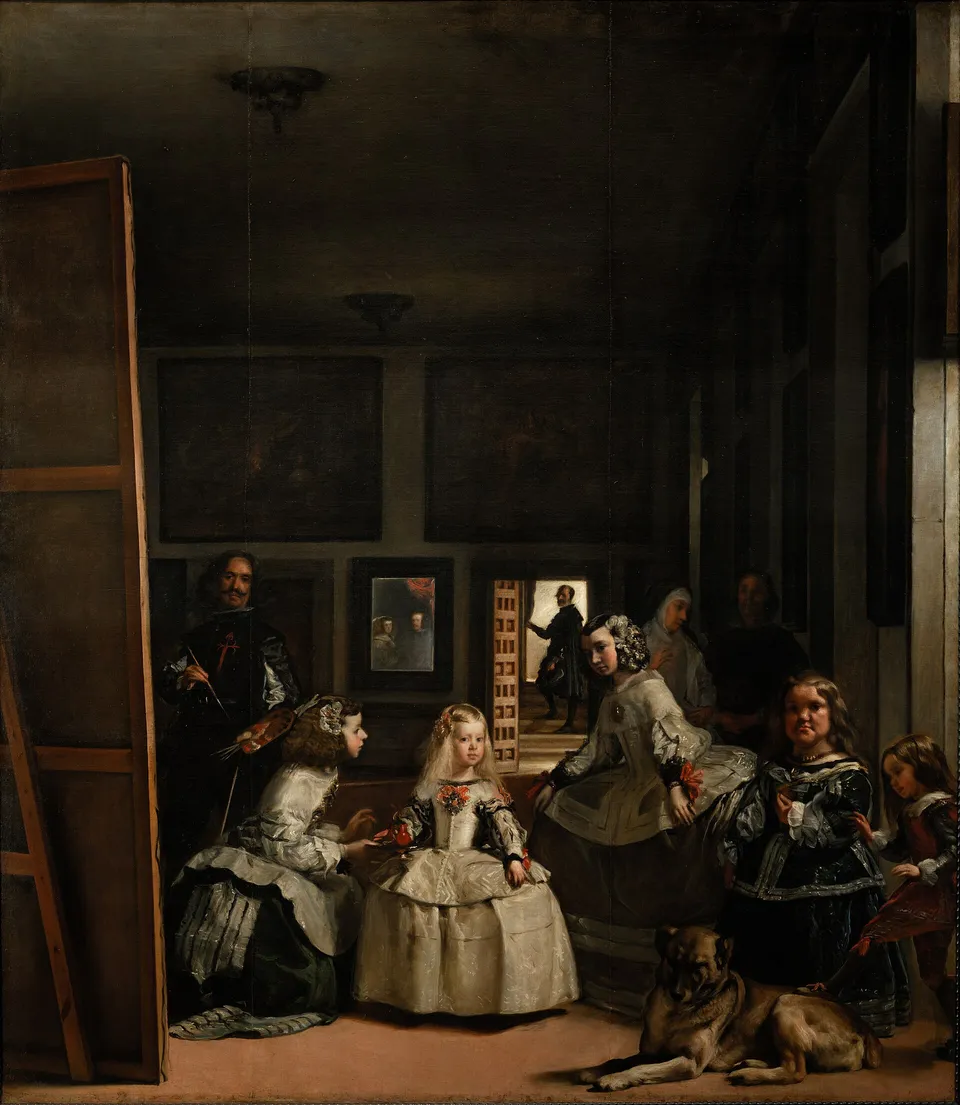
It is one of the earliest surviving full-length double portraits set in an interior, proving that portraiture could be as complex as history painting. Its use of a mirror to extend the space inspired Velázquez's Las Meninas two centuries later.
It also set the Northern tradition of hiding symbolism in everyday objects, a thread that runs through Dutch Golden Age genre painting and still fascinates scholars today.