Morning in a Paris café: a woman sits slumped before a glass of pale green absinthe, shoulders sagging, eyes empty, while the man beside her, pipe in mouth, looks away. Side by side, they seem to inhabit different worlds. With an almost snapshot-like composition, Degas captured the loneliness and dejection of city life.
Key facts
- Artist
- Edgar Degas1834–1917 · French
- Date
- 1875–1876
- Period
- Impressionism1860–1890
- Medium
- Oil on canvas
- Dimensions
- 92 × 68.5 cm
- Location
- Musée d'Orsay Paris, France
Actual size
Compared with an adult 170 cm tall
Palette
#847D61#9C967A#3E3429#261C18#605844Background
Originally titled In a Café, it is set in the Nouvelle Athènes café on the Place Pigalle in Paris, a favourite meeting place of Degas, Manet and their circle.
Both figures were posed by Degas's friends: the woman is the actress Ellen Andrée, the man the painter and printmaker Marcellin Desboutin. They were acting a part; in real life neither was a down-and-out drinker.
When it was shown in London in 1893 it caused an uproar: some critics denounced it as immoral, a glorification of drink, while others defended it. It was later bought by the collector Isaac de Camondo, who bequeathed it to the French state; it is now in the Musée d'Orsay.
Technique & composition
Degas pushes the figures to the upper right and gives the foreground to . The tables have no visible legs and seem to float, and we feel as though we are sitting at the next table, glimpsing the scene by chance. The off-centre, cropped composition reflects Japanese prints and photography.
The palette is grey, brown and off-white, with only giving off a faint green. reflects the pair as blurred shadows, adding to the haze.
Details
Symbolism
The green fairy
Absinthe, nicknamed “the green fairy”, was very strong and hugely popular in nineteenth-century Paris; it was believed to cause addiction and madness. France banned it in 1915. The glass in the picture thus became a symbol of dissipation and emptiness.
Alone together
stares into space and looks out of the picture; there is no contact between them. Degas does not moralise; he coolly records the alienation of modern city dwellers.
Stories
- Did you know?
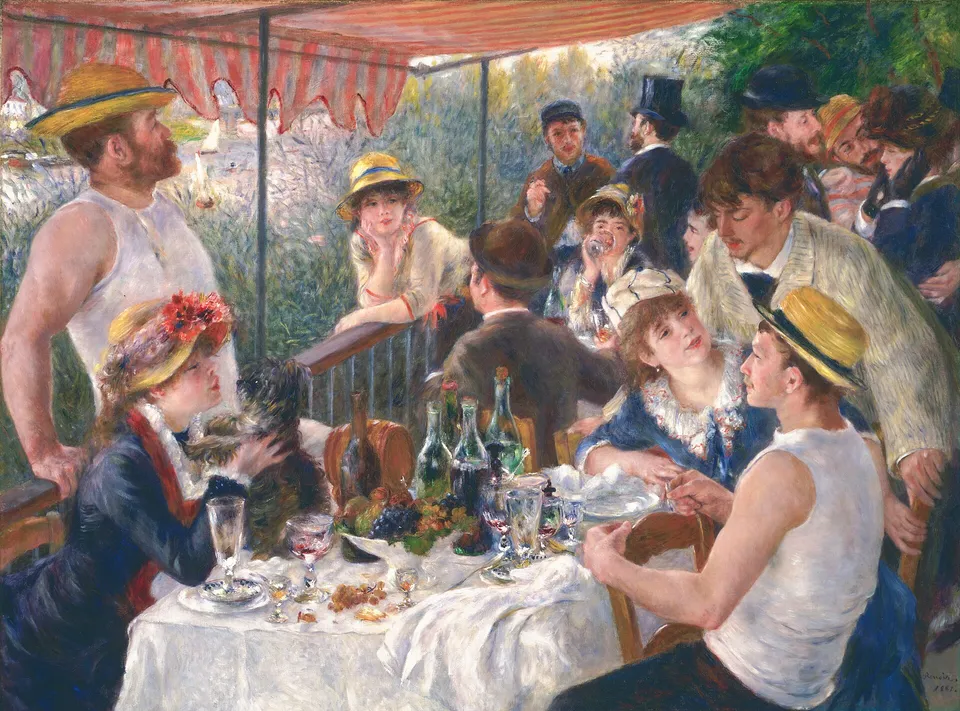
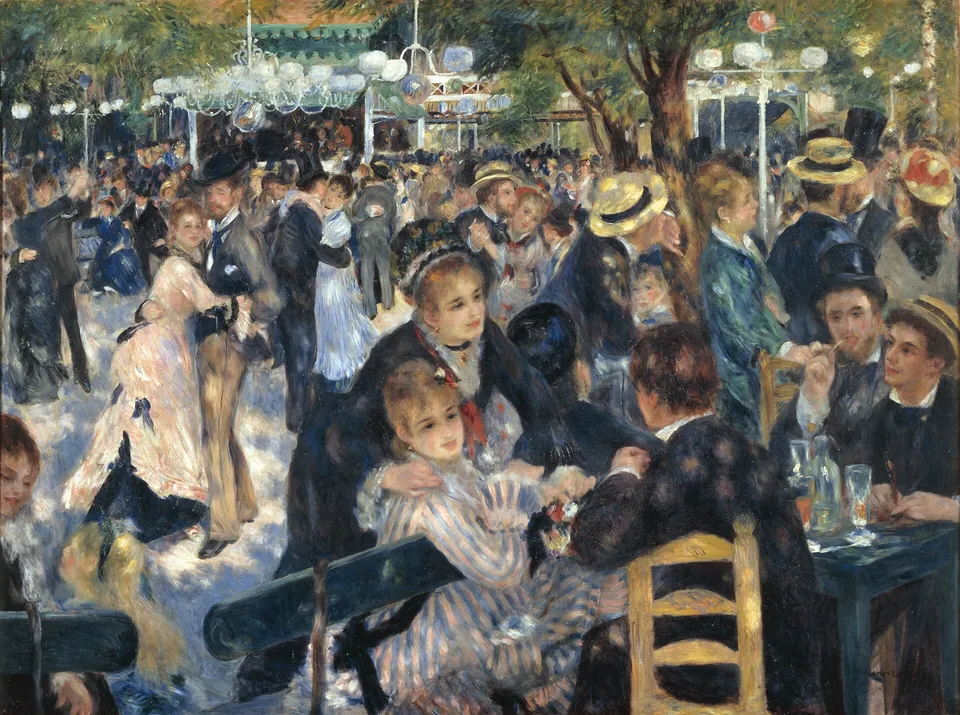
After the controversy, Ellen Andrée and Desboutin both worried for their reputations, and Degas is said to have had to state publicly that they were not alcoholics. Andrée also appears in Renoir's Luncheon of the Boating Party.
- Did you know?
was the kind cafés provided for customers. Degas placed on the foreground table top, and held water for diluting the absinthe.
Legacy
L'Absinthe is regarded as a classic image of modern urban loneliness and influenced many later pictures of cafés and drinkers, such as Picasso's The Absinthe Drinker. It is also a key nineteenth-century image in debates on drink and society.