Beneath the iron-and-glass shed of the Gare Saint-Lazare in Paris, a locomotive puffs out blue-white steam, sunlight pours through the roof, and distant buildings loom through the haze. Monet turned the noisiest scene of modern industry into a shifting field of light and colour — his first series of repeated views of a single place.
Key facts
- Artist
- Claude Monet1840–1926 · French
- Date
- 1877
- Period
- Impressionism1860–1890
- Medium
- Oil on canvas
- Dimensions
- 75 × 104 cm
- Location
- Musée d'Orsay Paris, France
Actual size
Compared with an adult 170 cm tall
Palette
#6B645B#8E8A8A#7E786F#A39F9B#544F49Background
The Gare Saint-Lazare was the busiest station in Paris, the terminus for trains to the Normandy coast. Monet was then living at Argenteuil, north-west of Paris, and arrived here every time he came into town; he knew it intimately.
Early in 1877 he rented a small studio near the station, the rent paid by his friend Caillebotte. In barely three months he painted twelve canvases of the station, seven of which were shown at the third Impressionist exhibition that April.
This version was bought by Caillebotte. On his death he bequeathed his collection of Impressionist paintings to the French state, making this one of the first Impressionist works to enter the national collections. It is now in the Musée d'Orsay.
Technique & composition
, with its dark iron trusses, forms a firm frame, yet inside it all is shifting and light. Monet layered the smoke in thick and thin strokes of blue, violet and white, setting the hard ironwork against the soft vapour.
Nothing has a crisp outline: almost dissolves into the smoke, and are merely hinted at in pale yellow and pinkish violet. What Monet painted was not the train itself but the atmosphere woven from steam, sunlight and air.
Details
Symbolism
A hymn to modern life
The railway was the defining invention of the nineteenth century. Academic painters thought stations ugly and unworthy of art; Monet treated this one as a modern cathedral. The novelist Émile Zola praised the pictures, saying that before them one could almost hear the rumble of the trains and see the smoke billowing under the vast sheds.
Travellers and the city
are a few quick strokes — the anonymous, hurrying people of the modern city. The station linked Paris to its suburbs and the coast, and stood for the quickening pace of urban life.
Stories
- Did you know?
According to Renoir's son, the film director Jean Renoir, Monet put on his finest clothes and presented himself to the stationmaster as “the painter Claude Monet”. The flattered official not only let him paint on the platforms but had trains held and their fireboxes stoked so that he could paint as much steam as he wished.
- Did you know?
reads “Claude Monet 1877”. waits in the shadow, a dark counterpart to the locomotive in the centre.
Legacy
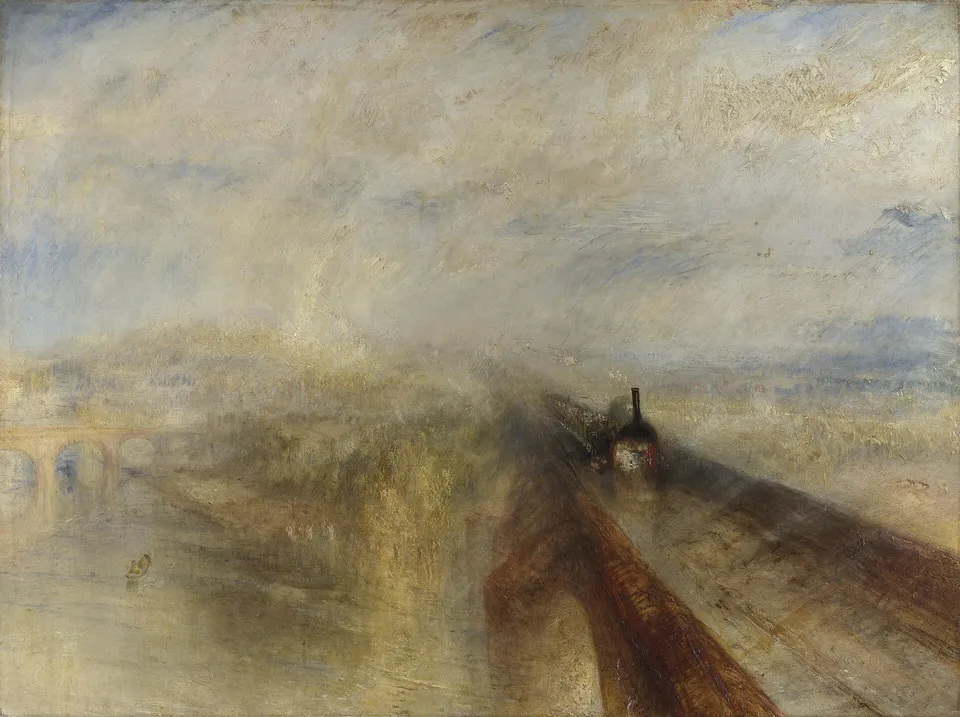
The Gare Saint-Lazare paintings were Monet's first series on a single motif, leading to his later series of Haystacks, Rouen Cathedral and Water Lilies. Like Turner's Rain, Steam and Speed, they became a classic response of art to the industrial age.