On a canvas almost six metres wide, Courbet places himself at the centre, painting a landscape at his easel, a nude model behind him and a small boy looking up. On the left crowd the people of every class; on the right stand the friends and collectors who supported him. Subtitled “A Real Allegory Summing Up Seven Years of My Artistic and Moral Life”, it is the manifesto of Realism.
Key facts
- Artist
- Gustave Courbet1819–1877 · French
- Date
- 1854–1855
- Period
- Realism1840–1880
- Medium
- Oil on canvas
- Dimensions
- 361 × 598 cm
- Location
- Musée d'Orsay Paris, France
Actual size
Compared with an adult 170 cm tall
Palette
#1F1A16#786452#342C27#534639#A48C72Background
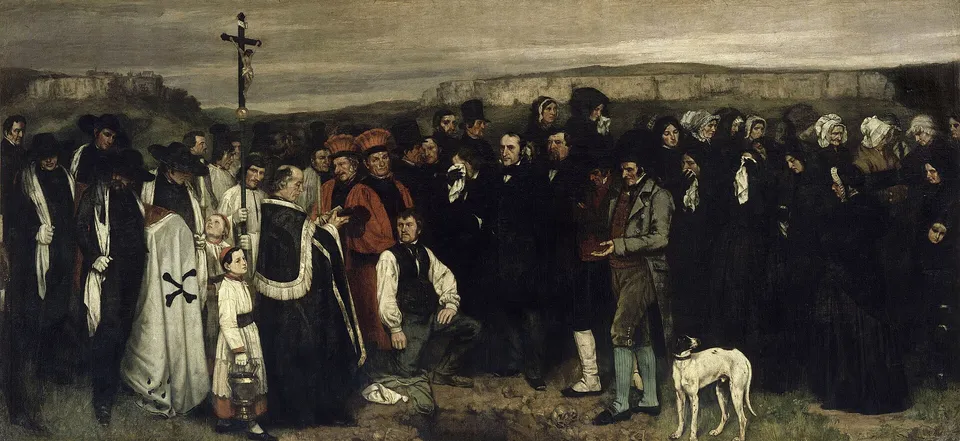
In 1855 Paris held a World's Fair. The jury accepted eleven of Courbet's works but rejected this painting and A Burial at Ornans. Refusing to give in, Courbet built his own Pavilion of Realism beside the fair at his own expense and showed some forty works there.
In a letter to the writer Champfleury, Courbet explained that on the right are “the shareholders” — friends, workers and art lovers — and on the left “the other world”: the common people, the poor, the rich, the exploited and the exploiters. The painter sits between the two.
The painting never sold in Courbet's lifetime. In 1920 the Louvre acquired it with the help of a public subscription; it is now in the Musée d'Orsay.
Technique & composition
Realism demanded painting only what one sees, yet this picture is an allegory. Courbet renders each figure realistically, but together they form a symbolic image: is at work on , not a myth or a history, declaring that art should draw on the real world.
The vast canvas, dim interior light and heavy browns give the scene the gravity of a history painting. A shaft of light falls on , leading the eye to the painter.
Details
Symbolism
Realism and tradition
has been read as the muse of Realism, or as the academic tradition the painter turns his back on; she watches him work instead of posing. neglected behind the canvas stands for the old academic tradition of models and classical prototypes.
The innocent eye
and stand for an eye free of prejudice. Courbet implies that those who truly see Realist art are those unbound by academic rules.
Stories
- Did you know?
. Beside him Courbet had painted his mistress Jeanne Duval, later painted out at the poet's request; as the paint has thinned with age her outline can still be faintly seen — a .
- Did you know?
Some scholars see as an allusion to Napoleon III, casting the emperor as a poacher preying on the nation. also includes a Jewish man and an Irishwoman Courbet had seen in London in 1848, a priest, a labourer and others.
- Did you know?
After visiting the Pavilion of Realism, Delacroix wrote in his journal that the jury had rejected “one of the most remarkable works of our time”.
Legacy
The Painter's Studio casts the artist as the centre and witness of society, a forerunner of the modern artist's manifesto. Courbet's defiance in staging his own exhibition against the official jury inspired the later Salon des Refusés and the independent Impressionist exhibitions.